


Page 72 - Read Online
P. 72
Page 4 of 7          Ballestri et al. Metab Target Organ Damage 2023;3:13  https://dx.doi.org/10.20517/mtod.2023.21


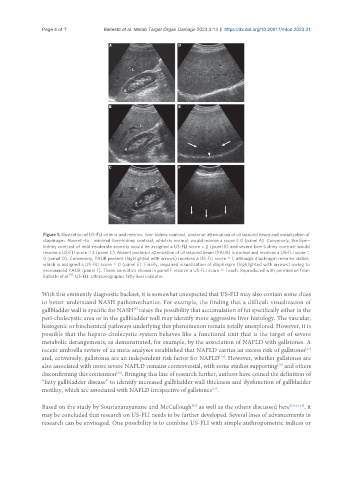
                Figure 1. Illustration of US-FLI criteria and metrics: liver-kidney contrast, posterior attenuation of ultrasound beam and visualization of
                diaphragm. Absent -to – minimal liver-kidney contrast, which is normal, would receive a score = 0 (panel A). Conversely, the liver-
                kidney contrast of mild-moderate severity would be assigned a US-FLI score = 2 (panel B) and severe liver-kidney contrast would
                receive a US-FLI score = 3 (panel C). Absent posterior attenuation of ultrasound beam (PAUB) is normal and receives a US-FLI score =
                0 (panel D). Conversely, PAUB present (highlighted with arrows) receives a US-FLI score = 1, although diaphragm remains visible,
                which is assigned a US-FLI score = 0 (panel E). Finally, impaired visualization of diaphragm (highlighted with arrows) owing to
                pronounced PAUB (panel F). These semiotics shown in panel F receive a US-FLI score = 1 each. Reproduced with permission from
                        [9]
                Ballestri et al. . US-FLI: Ultrasonographic fatty liver indicator.
               With this eminently diagnostic backset, it is somewhat unexpected that US-FLI may also contain some clues
               to better understand NASH pathomechanics. For example, the finding that a difficult visualization of
               gallbladder wall is specific for NASH  raises the possibility that accumulation of fat specifically either in the
                                              [7]
               peri-cholecystic area or in the gallbladder wall may identify more aggressive liver histology. The vascular,
               histogenic or biochemical pathways underlying this phenomenon remain totally unexplored. However, it is
               possible that the hepato-cholecystic system behaves like a functional unit that is the target of severe
               metabolic derangements, as demonstrated, for example, by the association of NAFLD with gallstones. A
               recent umbrella review of 22 meta-analyses established that NAFLD carries an excess risk of gallstones
                                                                                                        [17]
               and, conversely, gallstones are an independent risk factor for NAFLD . However, whether gallstones are
                                                                           [18]
               also associated with more severe NAFLD remains controversial, with some studies supporting  and others
                                                                                              [19]
                                        [20]
               disconfirming this contention . Bringing this line of research further, authors have coined the definition of
               “fatty gallbladder disease” to identify increased gallbladder wall thickness and dysfunction of gallbladder
                                                                        [21]
               motility, which are associated with NAFLD irrespective of gallstones .
               Based on the study by Sourianarayanane and McCullough  as well as the others discussed here [7,9,11-13] , it
                                                                  [10]
               may be concluded that research on US-FLI needs to be further developed. Several lines of advancements in
               research can be envisaged. One possibility is to combine US-FLI with simple anthropometric indices or

