


Page 71 - Read Online
P. 71
Ballestri et al. Metab Target Organ Damage 2023;3:13  https://dx.doi.org/10.20517/mtod.2023.21  Page 3 of 7

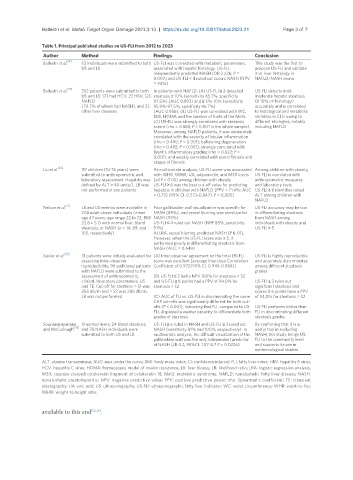
               Table 1. Principal published studies on US-FLI from 2012 to 2023
                Author       Method                  Findings                          Conclusion
                Ballestri et al. [9]  53 individuals were submitted to both  US-FLI was correlated with metabolic parameters,   This study was the first to
                             US and LB               associated with hepatic histology. US-FLI,   propose US-FLI and validate
                                                     independently predicted NASH (OR 2.236; P =   it vs. liver histology in
                                                     0.007) and US-FLI < 4 ruled out severe NASH (NPV  NAFLD/NASH arena
                                                     = 94%)
                Ballestri et al. [11]  352 patients were submitted to both  In patients with NAFLD: (A) US-FLI ≥ 2 detected  US-FLI detects mild-
                             US and LB: 173 had HCV, 23 HBV, 123  steatosis ≥ 10% (sensitivity 85.7%. specificity  moderate hepatic steatosis
                             NAFLD                   87.5%) (AUC 0.893) and ≥ 5%-10% (sensitivity  (≥ 10% on histology)
                             (70.7% of whom had NASH), and 33  95.9%-97.5%; specificity 66.7%)  accurately and is correlated
                             other liver diseases    (AUC 0.956). (B) US-FLI was correlated with WC,  to histological and metabolic
                                                     BMI, HOMA and the number of traits of the MetS.  variables in CLD owing to
                                                     (C) US-FLI was strongly correlated with steatosis  different etiologies, notably
                                                     extent (rho = 0.883; P < 0.001 in the whole sample).  including NAFLD
                                                     Moreover, among NAFLD patients, it was moderately
                                                     correlated with the severity of lobular inflammation
                                                     (rho = 0.490; P < 0.001); ballooning degeneration
                                                     (rho = 0.485; P < 0.001); strongly correlated with
                                                     Brunt’s inflammatory grading (rho = 0.622; P <
                                                     0.001); and weakly correlated with portal fibrosis and
                                                     stages of fibrosis
                     [12]
                Liu et al.   117 children (10-18 years) were   At multivariate analysis, US-FLI score was associated  Among children with obesity,
                             submitted to anthropometric and   with WHR, WHtR, UA, adiponectin, and M30 levels   US-FLI is correlated with
                             laboratory assessment. Hepatitis was  (all P < 0.05) among children with obesity   anthropometric measures
                             defined by ALT > 40 units/L. LB was  US-FLI ≥ 6 was the best cut-off value for predicting   and laboratory tests
                             not performed in any patients   hepatitis in children with NAFLD [PPV = 71.4%; AUC  US-FLI ≥ 6 identifies raised
                                                     = 0.710 (95% CI: 0.572-0.847); P = 0.005]  ALT among children with
                                                                                       NAFLD
                Nelson et al. [7]  LB and US metrics were available in   Poor gallbladder wall visualization was specific for   US-FLI accuracy may be low
                             208 adult obese individuals (mean   NASH (89%), and vessel blurring was sensitive for   in differentiating steatosis
                             age 47 years; age range 22 to 72; BMI  NASH (93%)         from NASH among
                             32.8 ± 5.1) with normal liver, bland   US-FLI ≤ 4 ruled out NASH (NPP 88%; sensitivity   individuals with obesity and
                             steatosis, or NASH (n = 14; 89; and   91%)                US-FLI ≥ 5
                             105, respectively)      At LRA, vessel blurring predicted NASH (P ≤ .01).
                                                     However, when the US-FLI score was ≥ 5, it
                                                     performed poorly in differentiating steatosis from
                                                     NASH (AUC = 0.649)
                       [13]
                Xavier et al.  31 patients were initially evaluated for  (A) Inter-observer agreement on the total US-FLI   US-FLI is highly reproducible
                             assessing inter-observer   score was excellent [average Interclass Correlation   and accurately discriminates
                             reproducibility; 96 additional patients  Coefficient of 0.972(95% CI: 0.949-0.986)]   among different steatosis
                             with NAFLD were submitted to the                          grades
                             assessment of anthropometric,   (B) US-FLI ≤ 3 had a NPV 100% for steatosis > S2
                             clinical, laboratory parameters, US   and US-FLI ≥ 6 points had a PPV of 94.0% for   US-FLI ≤ 3 rules out
                             and TE. Cut-off for steatosis > S1 was  steatosis > S2    significant steatosis and
                             268 dB/m and > S2 was 280 dB/m.                           scores ≥ 6 points have a PPV
                             LB was not performed    (C) AUC of FLI vs. US-FLI in discriminating the same  of 94,0% for steatosis > S2
                                                     CAP cut-offs was significantly different for both cut-
                                                     offs (P < 0.001), indicating that FLI, compared to US- US-FLI performs better than
                                                     FLI, displayed a weaker capacity to differentiate both  FLI in discriminating different
                                                     grades of steatosis               steatosis grades
                Sourianarayanane  11 normal livers; 24 bland steatosis;   US-FLI ≥ 6 ruled in NASH and US-FLI ≤ 3 ruled out   By confirming that it is a
                and McCullough [10]  and 78 NASH individuals were   NASH (sensitivity 81% and 100%, respectively). In   useful tool in excluding
                             submitted to both US and LB  multivariate analysis, the difficult visualization of the  NASH, this study brings US-
                                                     gallbladder wall was the only independent predictor   FLI to the community level
                                                     of NASH (LR 4.2, 95%CI: 1.07-8.7 P = 0.0226)   and supports its use in
                                                                                       epidemiological studies

               ALT: alanine transaminase; AUC: area under the curve; BMI: body mass index; CI: confidence interval; FLI: fatty liver index; HBV: hepatitis B virus;
               HCV: hepatitis C virus; HOMA: homeostasis model of insulin resistance; LB: liver biopsy; LR: likelihood ratio; LRA: logistic regression analysis;
               M30: caspase-cleaved cytokeratin fragment of cytokeratin 18; MetS: metabolic syndrome; NAFLD: nonalcoholic fatty liver disease; NASH:
               nonalcoholic steatohepatitis; NPV: negative predictive value; PPV: positive predictive power; rho: Spearman’s coefficient; TE: transient
               elastography; UA: uric acid; US: ultrasonography; US-FLI: ultrasonographic fatty liver indicator; WC: waist circumference; WHR: waist-to-hip;
               WHtR: weight-to-height ratio.


               available to this end [15,16] .

