


Page 55 - Read Online
P. 55
Page 4 of 17           Gulati et al. Metab Target Organ Damage 2024;4:9  https://dx.doi.org/10.20517/mtod.2023.45

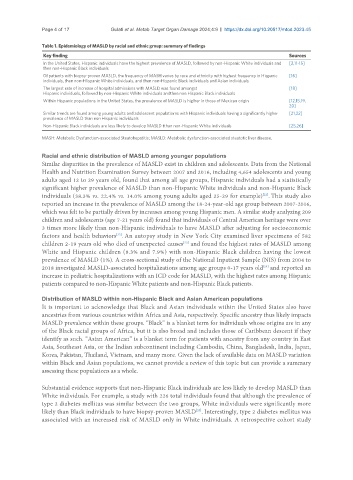
               Table 1. Epidemiology of MASLD by racial and ethnic group: summary of findings
                Key finding                                                                       Sources
                In the United States, Hispanic individuals have the highest prevalence of MASLD, followed by non-Hispanic White individuals and   [2,11-15]
                then non-Hispanic Black individuals
                Of patients with biopsy-proven MASLD, the frequency of MASH varies by race and ethnicity with highest frequency in Hispanic   [16]
                individuals, then non-Hlispanic White individuals, and then non-Hispanic Black individuals and Asian individuals
                The largest rate of increase of hospital admissions with MASLD was found amongst   [18]
                Hispanic individuals, followed by non-Hispanic White individuals andthen non Hispanic Black individuals
                Within Hispanic populations in the United States, the prevalence of MASLD is higlher in those of Mexican origin   [12,15,19,
                                                                                                  20]
                Similar trends are found among young adults and adolescent populatiorns with Hispanic individuals having a significantly higher   [21,22]
                prevalence of MASLD than non Hispanic individuals
                Non-Hispanic Black individuals are less likely to develop MASLD tthan non-Hispanic White individuals   [25,26]

               MASH: Metabolic Dysfunction-associated Steatohepatitis; MASLD: Metabolic dysfunction-associated steatotic liver disease.

               Racial and ethnic distribution of MASLD among younger populations
               Similar disparities in the prevalence of MASLD exist in children and adolescents. Data from the National
               Health and Nutrition Examination Survey between 2007 and 2016, including 4,654 adolescents and young
               adults aged 12 to 29 years old, found that among all age groups, Hispanic individuals had a statistically
               significant higher prevalence of MASLD than non-Hispanic White individuals and non-Hispanic Black
               individuals (38.3% vs. 22.4% vs. 14.0% among young adults aged 25-29 for example) . This study also
                                                                                          [21]
               reported an increase in the prevalence of MASLD among the 18-24-year-old age group between 2007-2016,
               which was felt to be partially driven by increases among young Hispanic men. A similar study analyzing 209
               children and adolescents (age 7-21 years old) found that individuals of Central American heritage were over
               3 times more likely than non-Hispanic individuals to have MASLD after adjusting for socioeconomic
               factors and health behaviors . An autopsy study in New York City examined liver specimens of 582
                                        [22]
                                                               [23]
               children 2-19 years old who died of unexpected causes  and found the highest rates of MASLD among
               White and Hispanic children (8.3% and 7.9%) with non-Hispanic Black children having the lowest
               prevalence of MASLD (1%). A cross-sectional study of the National Inpatient Sample (NIS) from 2004 to
               2018 investigated MASLD-associated hospitalizations among age groups 0-17 years old  and reported an
                                                                                          [24]
               increase in pediatric hospitalizations with an ICD code for MASLD, with the highest rates among Hispanic
               patients compared to non-Hispanic White patients and non-Hispanic Black patients.

               Distribution of MASLD within non-Hispanic Black and Asian American populations
               It is important to acknowledge that Black and Asian individuals within the United States also have
               ancestries from various countries within Africa and Asia, respectively. Specific ancestry thus likely impacts
               MASLD prevalence within these groups. “Black” is a blanket term for individuals whose origins are in any
               of the Black racial groups of Africa, but it is also broad and includes those of Caribbean descent if they
               identify as such. “Asian American” is a blanket term for patients with ancestry from any country in East
               Asia, Southeast Asia, or the Indian subcontinent including Cambodia, China, Bangladesh, India, Japan,
               Korea, Pakistan, Thailand, Vietnam, and many more. Given the lack of available data on MASLD variation
               within Black and Asian populations, we cannot provide a review of this topic but can provide a summary
               assessing these populations as a whole.


               Substantial evidence supports that non-Hispanic Black individuals are less likely to develop MASLD than
               White individuals. For example, a study with 226 total individuals found that although the prevalence of
               type 2 diabetes mellitus was similar between the two groups, White individuals were significantly more
               likely than Black individuals to have biopsy-proven MASLD . Interestingly, type 2 diabetes mellitus was
                                                                   [25]
               associated with an increased risk of MASLD only in White individuals. A retrospective cohort study

