


Page 60 - Read Online
P. 60
Poznyak et al. Microbiome Res Rep. 2026;5:3                                       Page 7 of 23


               Table 2. Therapeutic strategies targeting gut microbiota in preclinical RA
               Intervention   Mechanism         Evidence               Future directions       References

                              Modulates gut microbiota  Mediterranean and vegetarian  Investigate long-term effects and
               Dietary changes                                                                 [116-119,124-128]
                              composition       diets reduce RA activity  specific dietary components
                              Restores microflora  Mixed results; some studies show  Explore specific strains beneficial for
               Probiotics                                                                      [78-80,116-118]
                              balance           symptom relief         RA prevention
                              Restores gut microbiome  Show promise in animal models;  Protocol standardization and
               FMT                                                                             [144-156]
                              from healthy donors  variable human results  long-term safety assessments
               MicroRNA       Alters gut immune  Emerging research linking miRNAs  Clinical trials to assess efficacy in  [180-202]
               modulation     responses         to microbiome composition  RA prevention
               RA: Rheumatoid arthritis; FMT: fecal microbiota transplantation.

               Limosilactobacillus fermentum ME-3, have been shown to enhance regulatory T-cell responses, improve
               epithelial barrier integrity, and increase short-chain fatty acid (SCFA) production in experimental systems.
               These divergent effects highlight that functional outcomes cannot be inferred at the genus level. Instead,
               biological activity is highly dependent on strain-level genomic and metabolic properties and their interaction
               with host immune networks. Rigorous strain-level characterization is therefore essential for interpreting
               reported effects and for the rational design of microbiota-based interventions in RA [63,89] .


               TRANSFORMING THE GUT-JOINT AXIS
               Multiple microbiota-targeted interventions, including dietary modification, probiotics, FMT, and
               miRNA-based approaches, have been investigated for their potential roles in preclinical RA, with proposed
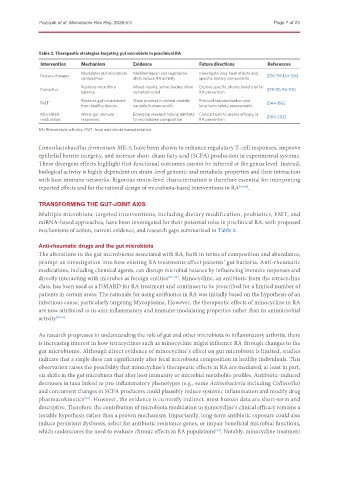
               mechanisms of action, current evidence, and research gaps summarized in Table 2.


               Anti-rheumatic drugs and the gut microbiota
               The alterations in the gut microbiome associated with RA, both in terms of composition and abundance,
               prompt an investigation into how existing RA treatments affect patients’ gut bacteria. Anti-rheumatic
               medications, including chemical agents, can disrupt microbial balance by influencing immune responses and
               directly interacting with microbes as foreign entities [90-92] . Minocycline, an antibiotic from the tetracycline
               class, has been used as a DMARD for RA treatment and continues to be prescribed for a limited number of
               patients in certain areas. The rationale for using antibiotics in RA was initially based on the hypothesis of an
               infectious cause, particularly targeting Mycoplasma. However, the therapeutic effects of minocycline in RA
               are now attributed to its anti-inflammatory and immune-modulating properties rather than its antimicrobial
               activity [93,94] .

               As research progresses in understanding the role of gut and other microbiota in inflammatory arthritis, there
               is increasing interest in how tetracyclines such as minocycline might influence RA through changes to the
               gut microbiome. Although direct evidence of minocycline’s effect on gut microbiota is limited, studies
               indicate that a single dose can significantly alter fecal microbiota composition in healthy individuals. This
               observation raises the possibility that minocycline’s therapeutic effects in RA are mediated, at least in part,
               via shifts in the gut microbiota that alter host immunity or microbial metabolite profiles. Antibiotic-induced
               decreases in taxa linked to pro-inflammatory phenotypes (e.g., some Actinobacteria including Collinsella)
               and concurrent changes in SCFA producers could plausibly reduce systemic inflammation and modify drug
               pharmacokinetics . However, the evidence is currently indirect: most human data are short-term and
                               [95]
               descriptive. Therefore, the contribution of microbiota modulation to minocycline’s clinical efficacy remains a
               testable hypothesis rather than a proven mechanism. Importantly, long-term antibiotic exposure could also
               induce persistent dysbiosis, select for antibiotic resistance genes, or impair beneficial microbial functions,
               which underscores the need to evaluate chronic effects in RA populations . Notably, minocycline treatment
                                                                             [96]

