


Page 56 - Read Online
P. 56
Poznyak et al. Microbiome Res Rep. 2026;5:3                                       Page 3 of 23


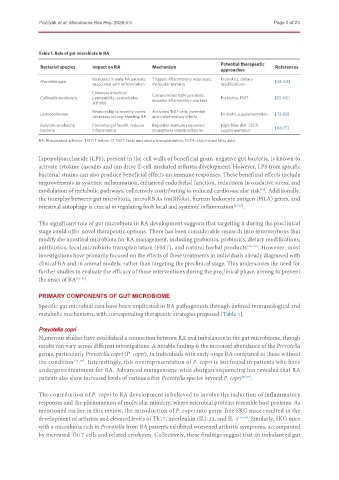
               Table 1. Role of gut microbiota in RA
                                                                               Potential therapeutic
               Bacterial species  Impact on RA        Mechanism                                   References
                                                                               approaches
                                 Increased in early RA patients;  Triggers inflammatory responses;  Probiotics, dietary
               Prevotella copri                                                                   [34-54]
                                 associated with inflammation  molecular mimicry  modifications
                                 Enhances intestinal
               Collinsella aerofaciens  permeability; exacerbates  Compromises tight junctions;  Prebiotics, FMT  [55-66]
                                 arthritis            elevates inflammatory markers
                                 Relationship to severity varies;  Activates Th17 cells; potential
               Lactobacillaceae                                                Probiotic supplementation  [72-82]
                                 decreases in long-standing RA  anti-inflammatory effects
               Butyrate-producing  Promotes gut health; reduces  Regulates immune responses;  High-fiber diet, SCFA
               bacteria          inflammation         strengthens intestinal barrier  supplementation  [64-71]
               RA: Rheumatoid arthritis; Th17: T helper 17; FMT: fecal microbiota transplantation; SCFA: short-chain fatty acid.


               Lipopolysaccharide (LPS), present in the cell walls of beneficial gram-negative gut bacteria, is known to
               activate cytokine cascades and can drive T-cell-mediated arthritis development. However, LPS from specific
               bacterial strains can also produce beneficial effects on immune responses. These beneficial effects include
               improvements in systemic inflammation, enhanced endothelial function, reductions in oxidative stress, and
               modulation of metabolic pathways, collectively contributing to reduced cardiovascular risk . Additionally,
                                                                                            [24]
               the interplay between gut microbiota, microRNAs (miRNAs), human leukocyte antigen (HLA) genes, and
               intestinal autophagy is crucial in regulating both local and systemic inflammation [25-27] .


               The significant role of gut microbiota in RA development suggests that targeting it during the preclinical
               stage could offer novel therapeutic options. There has been considerable research into interventions that
               modify the intestinal microbiota for RA management, including probiotics, prebiotics, dietary modifications,
               antibiotics, fecal microbiota transplantation (FMT), and natural herbal products [28-30] . However, most
               investigations have primarily focused on the effects of these treatments in individuals already diagnosed with
               clinical RA and in animal models, rather than targeting the preclinical stage. This underscores the need for
               further studies to evaluate the efficacy of these interventions during the preclinical phase, aiming to prevent
               the onset of RA [31-33] .


               PRIMARY COMPONENTS OF GUT MICROBIOME
               Specific gut microbial taxa have been implicated in RA pathogenesis through defined immunological and
               metabolic mechanisms, with corresponding therapeutic strategies proposed [Table 1].


               Prevotella copri
               Numerous studies have established a connection between RA and imbalances in the gut microbiome, though
               results can vary across different investigations. A notable finding is the increased abundance of the Prevotella
               genus, particularly Prevotella copri (P. copri), in individuals with early-stage RA compared to those without
               the condition [34,35] . Interestingly, this overrepresentation of P. copri is not found in patients who have
               undergone treatment for RA. Advanced metagenome-wide shotgun sequencing has revealed that RA
               patients also show increased levels of various other Prevotella species beyond P. copri [36,37] .

               The contribution of P. copri to RA development is believed to involve the induction of inflammatory
               responses and the phenomenon of molecular mimicry, where microbial proteins resemble host proteins. As
               mentioned earlier in this review, the introduction of P. copri into germ-free SKG mice resulted in the
               development of arthritis and elevated levels of Th17, interleukin (IL)-23, and IL-1 [38,39] . Similarly, SKG mice
               with a microbiota rich in Prevotella from RA patients exhibited worsened arthritis symptoms, accompanied
               by increased Th17 cells and related cytokines. Collectively, these findings suggest that an imbalanced gut

