Page 83 - Read Online
P. 83

Page 6 of 10            Eskander et al. Mini-invasive Surg 2024;8:32  https://dx.doi.org/10.20517/2574-1225.2024.71

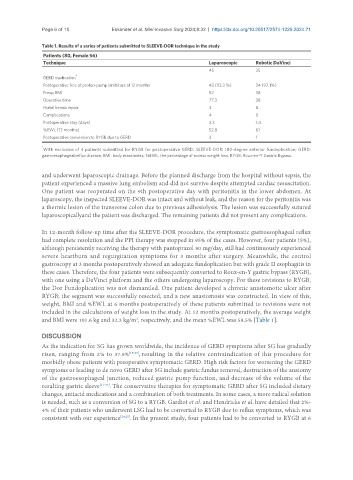
               Table 1. Results of a series of patients submitted to SLEEVE-DOR technique in the study
                Patients (80, Female 56)
                Technique                                              Laparoscopic    Robotic DaVinci
                                                                       45              35
                           *
                GERD medication
                Postoperative free of proton-pump inhibitors at 12 months  43 (93.3 %)  34 (97.1%)
                Preop BMI                                              52              38
                Operative time                                         77.3            38
                Hiatal hernia repair                                   3               8
                Complications                                          4               0
                Postoperative stay (days)                              2.3             1.4
                %EWL (12 months)                                       52.8            61
                Postoperative conversion to RYGB due to GERD           3               1

               *
                With exclusion of 4 patients submitted for RYGB for postoperative GERD. SLEEVE-DOR: 180-degree anterior fundoplication; GERD:
               gastroesophageal reflux disease; BMI: body mass index; %EWL: the percentage of excess weight loss; RYGB: Roux-en-Y Gastric Bypass.

               and underwent laparoscopic drainage. Before the planned discharge from the hospital without sepsis, the
               patient experienced a massive lung embolism and did not survive despite attempted cardiac resuscitation.
               One patient was reoperated on the 9th postoperative day with peritonitis in the lower abdomen. At
               laparoscopy, the inspected SLEEVE-DOR was intact and without leak, and the reason for the peritonitis was
               a thermic lesion of the transverse colon due to previous adhesiolysis. The lesion was successfully sutured
               laparoscopicallyand the patient was discharged. The remaining patients did not present any complications.


               In 12-month follow-up time after the SLEEVE-DOR procedure, the symptomatic gastroesophageal reflux
               had complete resolution and the PPI therapy was stopped in 95% of the cases. However, four patients (5%),
               although persistently receiving the therapy with pantoprazol 80 mg/day, still had continuously experienced
               severe heartburn and regurgitation symptoms for 3 months after surgery. Meanwhile, the control
               gastroscopy at 3 months postoperatively showed an adequate fundoplication but with grade II esophagitis in
               these cases. Therefore, the four patients were subsequently converted to Roux-en-Y gastric bypass (RYGB),
               with one using a DaVinci platform and the others undergoing laparoscopy. For these revisions to RYGB,
               the Dor Fundoplication was not dismantled. One patient developed a chronic anastomotic ulcer after
               RYGB; the segment was successfully resected, and a new anastomosis was constructed. In view of this,
               weight, BMI and %EWL at 6 months postoperatively of these patients submitted to revisions were not
               included in the calculations of weight loss in the study. At 12 months postoperatively, the average weight
                                               2
               and BMI were 101.6 kg and 32.3 kg/m , respectively, and the mean %EWL was 58.5% [Table 1].

               DISCUSSION
               As the indication for SG has grown worldwide, the incidence of GERD symptoms after SG has gradually
               risen, ranging from 2% to 37.9% [18-20] , resulting in the relative contraindication of this procedure for
               morbidly obese patients with preoperative symptomatic GERD. High risk factors for worsening the GERD
               symptoms or leading to de novo GERD after SG include gastric fundus removal, destruction of the anatomy
               of the gastroesophageal junction, reduced gastric pump function, and decrease of the volume of the
               resulting gastric sleeve [21-23] . The conservative therapies for symptomatic GERD after SG included dietary
               changes, antiacid medications and a combination of both treatments. In some cases, a more radical solution
               is needed, such as a conversion of SG to a RYGB. Gardiot et al. and Hendricks et al. have detailed that 2%-
               4% of their patients who underwent LSG had to be converted to RYGB due to reflux symptoms, which was
               consistent with our experience [24,25] . In the present study, four patients had to be converted to RYGB at 6
   78   79   80   81   82   83   84   85   86   87   88