Page 82 - Read Online
P. 82
Eskander et al. Mini-invasive Surg 2024;8:32 https://dx.doi.org/10.20517/2574-1225.2024.71 Page 5 of 10
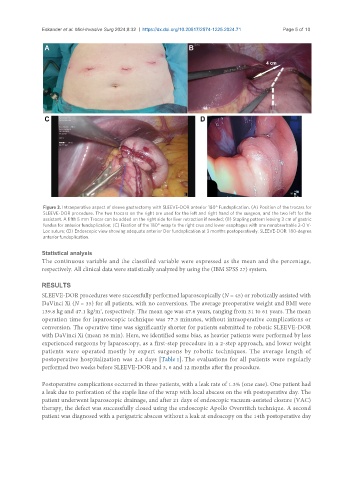
Figure 3. Intraoperative aspect of sleeve gastrectomy with SLEEVE-DOR anterior 180° Fundoplication. (A) Position of the trocars for
SLEEVE-DOR procedure. The two trocars on the right are used for the left and right hand of the surgeon, and the two left for the
assistant. A fifth 5 mm Trocar can be added on the right side for liver retraction if needed; (B) Stapling pattern leaving 3 cm of gastric
fundus for anterior fundoplication; (C) Fixation of the 180° wrap to the right crus and lower esophagus with one nonabsorbable 2-0 V-
Loc suture; (D) Endoscopic view showing adequate anterior Dor fundoplication at 3 months postoperatively. SLEEVE-DOR: 180-degree
anterior fundoplication.
Statistical analysis
The continuous variable and the classified variable were expressed as the mean and the percentage,
respectively. All clinical data were statistically analyzed by using the (IBM SPSS 27) system.
RESULTS
SLEEVE-DOR procedures were successfully performed laparoscopically (N = 45) or robotically assisted with
DaVinci Xi (N = 35) for all patients, with no conversions. The average preoperative weight and BMI were
2
139.8 kg and 47.1 kg/m , respectively. The mean age was 47.6 years, ranging from 31 to 61 years. The mean
operation time for laparoscopic technique was 77.3 minutes, without intraoperative complications or
conversion. The operative time was significantly shorter for patients submitted to robotic SLEEVE-DOR
with DaVinci Xi (mean 38 min). Here, we identified some bias, as heavier patients were performed by less
experienced surgeons by laparoscopy, as a first-step procedure in a 2-step approach, and lower weight
patients were operated mostly by expert surgeons by robotic techniques. The average length of
postoperative hospitalization was 2.4 days [Table 1]. The evaluations for all patients were regularly
performed two weeks before SLEEVE-DOR and 3, 6 and 12 months after the procedure.
Postoperative complications occurred in three patients, with a leak rate of 1.3% (one case). One patient had
a leak due to perforation of the staple line of the wrap with local abscess on the 9th postoperative day. The
patient underwent laparoscopic drainage, and after 21 days of endoscopic vacuum-assisted closure (VAC)
therapy, the defect was successfully closed using the endoscopic Apollo Overstitch technique. A second
patient was diagnosed with a perigastric abscess without a leak at endoscopy on the 14th postoperative day