Page 73 - Read Online
P. 73

Sánchez et al. Mini-invasive Surg 2024;8:36  https://dx.doi.org/10.20517/2574-1225.2024.72  Page 5 of 9

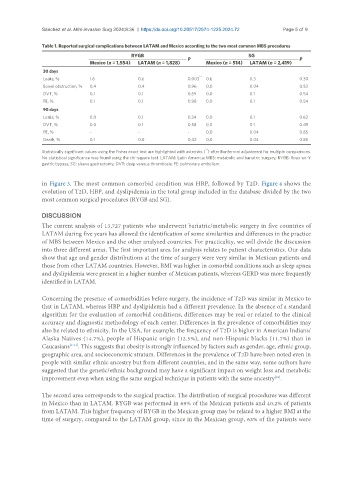
               Table 1. Reported surgical complications between LATAM and Mexico according to the two most common MBS procedures
                                             RYGB                                    SG
                               Mexico (n = 1,554)  LATAM (n = 1,828)  P  Mexico (n = 514)  LATAM (n = 2,419)  P
                30 days
                                                                    **
                Leaks, %       1.6              0.6             0.003  0.6           0.3              0.30
                Bowel obstruction, %  0.4       0.4             0.96  0.0            0.04             0.83
                DVT, %         0.1              0.1             0.59  0.0            0.1              0.54
                PE, %          0.1              0.1             0.98  0.0            0.1              0.54
                90 days
                Leaks, %       0.0              0.1             0.34  0.0            0.1              0.62
                DVT, %         0.0              0.1             0.58  0.3            0.1              0.49
                PE, %          -                -               -     0.0            0.04             0.85
                Death, %       0.1              0.0             0.42  0.0            0.04             0.85
                                                                      **
               Statistically significant values using the Fisher exact test are highlighted with asterisks ( ) after Bonferroni adjustment for multiple comparisons.
               No statistical significance was found using the chi-square test. LATAM: Latin America; MBS: metabolic and bariatric surgery; RYGB: Roux-en-Y
               gastric bypass; SG: sleeve gastrectomy; DVT: deep venous thrombosis; PE: pulmonary embolism.


               in Figure 3. The most common comorbid condition was HBP, followed by T2D. Figure 4 shows the
               evolution of T2D, HBP, and dyslipidemia in the total group included in the database divided by the two
               most common surgical procedures (RYGB and SG).


               DISCUSSION
               The current analysis of 13,727 patients who underwent bariatric/metabolic surgery in five countries of
               LATAM during five years has allowed the identification of some similarities and differences in the practice
               of MBS between Mexico and the other analyzed countries. For practicality, we will divide the discussion
               into three different areas. The first important area for analysis relates to patient characteristics. Our data
               show that age and gender distributions at the time of surgery were very similar in Mexican patients and
               those from other LATAM countries. However, BMI was higher in comorbid conditions such as sleep apnea
               and dyslipidemia were present in a higher number of Mexican patients, whereas GERD was more frequently
               identified in LATAM.


               Concerning the presence of comorbidities before surgery, the incidence of T2D was similar in Mexico to
               that in LATAM, whereas HBP and dyslipidemia had a different prevalence. In the absence of a standard
               algorithm for the evaluation of comorbid conditions, differences may be real or related to the clinical
               accuracy and diagnostic methodology of each center. Differences in the prevalence of comorbidities may
               also be related to ethnicity. In the USA, for example, the frequency of T2D is higher in American Indians/
               Alaska Natives (14.7%), people of Hispanic origin (12.5%), and non-Hispanic blacks (11.7%) than in
               Caucasians [9-11] . This suggests that obesity is strongly influenced by factors such as gender, age, ethnic group,
               geographic area, and socioeconomic stratum. Differences in the prevalence of T2D have been noted even in
               people with similar ethnic ancestry but from different countries, and in the same way, some authors have
               suggested that the genetic/ethnic background may have a significant impact on weight loss and metabolic
               improvement even when using the same surgical technique in patients with the same ancestry .
                                                                                              [12]
               The second area corresponds to the surgical practice. The distribution of surgical procedures was different
               in Mexico than in LATAM. RYGB was performed in 69% of the Mexican patients and 40.2% of patients
               from LATAM. This higher frequency of RYGB in the Mexican group may be related to a higher BMI at the
               time of surgery, compared to the LATAM group, since in the Mexican group, 63% of the patients were
   68   69   70   71   72   73   74   75   76   77   78