Page 65 - Read Online
P. 65
Spurzem et al. Mini-invasive Surg. 2025;9:10 https://dx.doi.org/10.20517/2574-1225.2024.96 Page 5 of 8
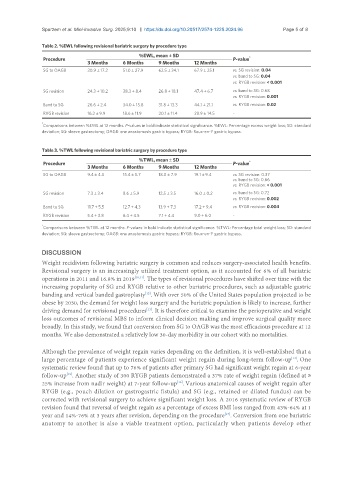
Table 2. %EWL following revisional bariatric surgery by procedure type
%EWL, mean ± SD
Procedure P-value *
3 Months 6 Months 9 Months 12 Months
SG to OAGB 30.9 ± 17.2 51.0 ± 27.9 62.5 ± 34.1 67.9 ± 25.1 vs. SG revision: 0.04
vs. band to SG: 0.04
vs. RYGB revision: < 0.001
SG revision 24.3 ± 10.2 38.3 ± 8.4 26.8 ± 18.1 47.4 ± 6.7 vs. band to SG: 0.68
vs. RYGB revision: 0.001
Band to SG 26.6 ± 2.4 34.0 ± 15.8 31.8 ± 13.3 44.1 ± 21.1 vs. RYGB revision: 0.02
RYGB revision 16.2 ± 9.9 18.6 ± 11.9 20.1 ± 11.4 28.9 ± 14.5 -
*
Comparisons between %EWL at 12 months. P-values in bold indicate statistical significance. %EWL: Percentage excess weight loss; SD: standard
deviation; SG: sleeve gastrectomy; OAGB: one anastomosis gastric bypass; RYGB: Roux-en-Y gastric bypass.
Table 3. %TWL following revisional bariatric surgery by procedure type
%TWL, mean ± SD
Procedure P-value *
3 Months 6 Months 9 Months 12 Months
SG to OAGB 9.4 ± 4.3 15.4 ± 5.7 18.0 ± 7.9 19.1 ± 9.4 vs. SG revision: 0.37
vs. band to SG: 0.66
vs. RYGB revision: < 0.001
SG revision 7.3 ± 3.4 8.6 ± 5.9 12.5 ± 3.5 16.0 ± 0.2 vs. band to SG: 0.72
vs. RYGB revision: 0.002
Band to SG 11.7 ± 5.5 12.7 ± 4.3 13.9 ± 7.3 17.2 ± 9.4 vs. RYGB revision: 0.004
RYGB revision 5.4 ± 3.8 6.4 ± 4.5 7.1 ± 4.4 9.0 ± 6.0 -
*
Comparisons between %TWL at 12 months. P-values in bold indicate statistical significance. %TWL: Percentage total weight loss; SD: standard
deviation; SG: sleeve gastrectomy; OAGB: one anastomosis gastric bypass; RYGB: Roux-en-Y gastric bypass.
DISCUSSION
Weight recidivism following bariatric surgery is common and reduces surgery-associated health benefits.
Revisional surgery is an increasingly utilized treatment option, as it accounted for 6% of all bariatric
operations in 2011 and 16.8% in 2019 [10,11] . The types of revisional procedures have shifted over time with the
increasing popularity of SG and RYGB relative to other bariatric procedures, such as adjustable gastric
banding and vertical banded gastroplasty . With over 50% of the United States population projected to be
[12]
obese by 2030, the demand for weight loss surgery and the bariatric population is likely to increase, further
driving demand for revisional procedures . It is therefore critical to examine the perioperative and weight
[13]
loss outcomes of revisional MBS to inform clinical decision making and improve surgical quality more
broadly. In this study, we found that conversion from SG to OAGB was the most efficacious procedure at 12
months. We also demonstrated a relatively low 30-day morbidity in our cohort with no mortalities.
Although the prevalence of weight regain varies depending on the definition, it is well-established that a
large percentage of patients experience significant weight regain during long-term follow-up . One
[14]
systematic review found that up to 76% of patients after primary SG had significant weight regain at 6-year
follow-up . Another study of 300 RYGB patients demonstrated a 37% rate of weight regain (defined at ≥
[15]
25% increase from nadir weight) at 7-year follow-up . Various anatomical causes of weight regain after
[16]
RYGB (e.g., pouch dilation or gastrogastric fistula) and SG (e.g., retained or dilated fundus) can be
corrected with revisional surgery to achieve significant weight loss. A 2016 systematic review of RYGB
revision found that reversal of weight regain as a percentage of excess BMI loss ranged from 43%-64% at 1
year and 14%-76% at 3 years after revision, depending on the procedure . Conversion from one bariatric
[17]
anatomy to another is also a viable treatment option, particularly when patients develop other