


Page 37 - Read Online
P. 37
Page 6 of 15            Okafor et al. Mini-invasive Surg 2024;8:28  https://dx.doi.org/10.20517/2574-1225.2023.128

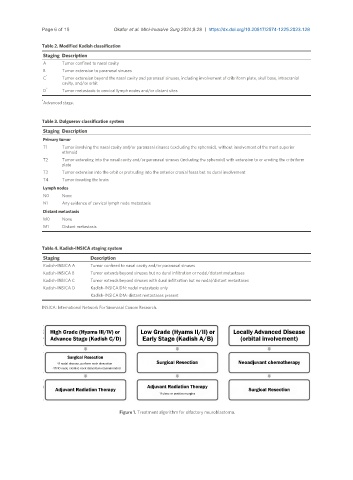
               Table 2. Modified Kadish classification
                Staging Description
                A     Tumor confined to nasal cavity
                B     Tumor extension to paranasal sinuses
                 *
                C     Tumor extension beyond the nasal cavity and paranasal sinuses, including involvement of cribriform plate, skull base, intracranial
                      cavity, and/or orbit
                 *
                D     Tumor metastasis to cervical lymph nodes and/or distant sites
               *
                Advanced stage.

               Table 3. Dulguerov classification system
                Staging Description
                Primary tumor
                T1    Tumor involving the nasal cavity and/or paranasal sinuses (excluding the sphenoid), without involvement of the most superior
                      ethmoid
                T2    Tumor extending into the nasal cavity and/or paranasal sinuses (including the sphenoid) with extension to or eroding the cribriform
                      plate
                T3    Tumor extension into the orbit or protruding into the anterior cranial fossa but no dural involvement
                T4    Tumor invading the brain
                Lymph nodes
                N0    None
                N1    Any evidence of cervical lymph node metastasis
                Distant metastasis
                M0    None
                M1    Distant metastasis


               Table 4. Kadish-INSICA staging system
                Staging         Description
                Kadish-INSICA A  Tumor confined to nasal cavity and/or paranasal sinuses
                Kadish-INSICA B  Tumor extends beyond sinuses but no dural infiltration or nodal/distant metastases
                Kadish-INSICA C  Tumor extends beyond sinuses with dural infiltration but no nodal/distant metastases
                Kadish-INSICA D  Kadish-INSICA DN: nodal metastasis only
                                Kadish-INSICA DM: distant metastases present
               INSICA: International Network For Sinonasal Cancer Research.


                                         Figure 1. Treatment algorithm for olfactory neuroblastoma.

