


Page 60 - Read Online
P. 60
Hambright et al. Mini-invasive Surg 2024;8:19  https://dx.doi.org/10.20517/2574-1225.2024.08  Page 3 of 12

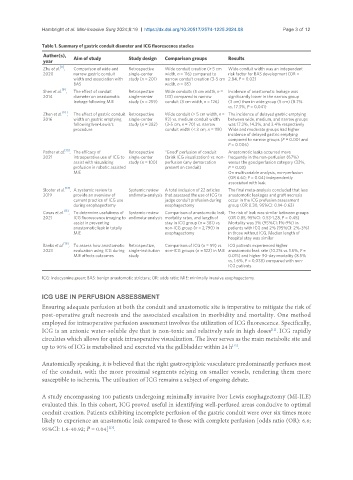
               Table 1. Summary of gastric conduit diameter and ICG fluorescence studies
                Author(s),  Aim of study    Study design  Comparison groups   Results
                year
                     [8]
                Zhu et al. ,  Comparison of wide and   Retrospective   Wide conduit creation (> 5 cm   Wide conduit width was an independent
                2020      narrow gastric conduit   single-center   width, n = 116) compared to   risk factor for BAS development (OR =
                          width and association with   study (n = 201)  narrow conduit creation (3-5 cm  2.84, P = 0.02)
                          BAS                            width, n = 85)
                      [9]
                Shen et al. ,   The effect of conduit   Retrospective   Wide conduits (5 cm width, n =  Incidence of anastomotic leakage was
                2014      diameter on anastomotic   single-center   133) compared to narrow   significantly lower in the narrow group
                          leakage following MIE  study (n = 259)  conduit (3 cm width, n = 126)  (3 cm) than in wide group (5 cm) (8.7%
                                                                              vs. 17.3%, P = 0.041)
                Zhen et al. [10] ,  The effect of gastric conduit  Retrospective   Wide conduit (> 5 cm width, n =  The incidence of delayed gastric emptying
                2016      width on gastric emptying   single-center   93) vs. medium conduit width   between wide, medium, and narrow groups
                          following Ivor-Lewis’s   study (n = 282)  (3-5 cm, n = 70) vs. narrow   was 17.2%, 14.3%, and 3.4% respectively
                          procedure                      conduit width (< 3 cm, n = 119)  Wide and moderate groups had higher
                                                                              incidence of delayed gastric emptying
                                                                              compared to narrow groups (P = 0.001 and
                                                                              P = 0.006)
                       [13]
                Pather et al.  ,  The efficacy of   Retrospective   “Good” perfusion of conduit   Anastomotic leaks occurred more
                2021      intraoperative use of ICG to  single-center   (brisk ICG visualization) vs. non- frequently in the non-perfusion (67%)
                          assist with visualizing   study (n = 100)  perfusion (any demarcation   versus the good perfusion category (33%,
                          profusion in robotic assisted   present on conduit)  P = 0.03)
                          MIE                                                 On multivariable analysis, non-perfusion
                                                                              (OR 6.60; P = 0.04) independently
                                                                              associated with leak
                       [14]
                Slooter et al.  , A systemic review to   Systemic review   A total inclusion of 22 articles   The final meta-analysis concluded that less
                2019      provide an overview of   and meta-analysis that assessed the use of ICG to   anastomotic leakages and graft necrosis
                          current practice of ICG use    judge conduit profusion during   occur in the ICG prefusion assessment
                          during esophagectomy           esophagectomy        group (OR 0.30, 95%CI: 0.14-0.63)
                       [15]
                Casas et al.  ,  To determine usefulness of  Systemic review   Comparison of anastomotic leak,  The risk of leak was similar between groups
                2021      ICG fluorescence imaging to  and meta-analysis mortality rates, and length of   (OR 0.85, 95%CI: 0.53-1.28, P = 0.45)
                          assist in preventing           stay in ICG group (n = 381) vs.   Mortality was 3% (95%CI: 1%-9%) in
                          anastomotic leak in totally    non-ICG group (n = 2,790) in   patients with ICG and 2% (95%CI: 2%-3%)
                          MIE                            esophagectomy        in those without ICG. Median length of
                                                                              hospital stay was similar
                Banks et al. [16] ,  To assess how anastomotic  Retrospective,   Comparison of ICG (n = 59) vs.   ICG patients experienced higher
                2023      evaluation using ICG during  single-institution  non-ICG groups (n = 122) in MIE anastomotic leak rate (10.2% vs. 1.6%, P =
                          MIE affects outcomes  study                         0.015) and higher 90-day mortality (8.5%
                                                                              vs. 1.6%, P = 0.038) compared with non-
                                                                              ICG patients
               ICG: Indocyanine green; BAS: benign anastomotic stricture; OR: odds ratio; MIE: minimally invasive esophagectomy.


               ICG USE IN PERFUSION ASSESSMENT
               Ensuring adequate perfusion at both the conduit and anastomotic site is imperative to mitigate the risk of
               post-operative graft necrosis and the associated escalation in morbidity and mortality. One method
               employed for intraoperative perfusion assessment involves the utilization of ICG fluorescence. Specifically,
               ICG is an anionic water-soluble dye that is non-toxic and relatively safe in high doses . ICG rapidly
                                                                                            [11]
               circulates which allows for quick intraoperative visualization. The liver serves as the main metabolic site and
               up to 90% of ICG is metabolized and excreted via the gallbladder within 24 h .
                                                                               [12]

               Anatomically speaking, it is believed that the right gastroepiploic vasculature predominantly perfuses most
               of the conduit, with the more proximal segments relying on smaller vessels, rendering them more
               susceptible to ischemia. The utilization of ICG remains a subject of ongoing debate.


               A study encompassing 100 patients undergoing minimally invasive Ivor Lewis esophagectomy (MI-ILE)
               evaluated this. In this cohort, ICG proved useful in identifying well-perfused areas conducive to optimal
               conduit creation. Patients exhibiting incomplete perfusion of the gastric conduit were over six times more
               likely to experience an anastomotic leak compared to those with complete perfusion [odds ratio (OR): 6.6;
               95%CI: 1.6-40.92; P = 0.04] .
                                      [13]

