


Page 22 - Read Online
P. 22
Bone et al. J Transl Genet Genom 2022;6:169-78  https://dx.doi.org/10.20517/jtgg.2021.56  Page 173

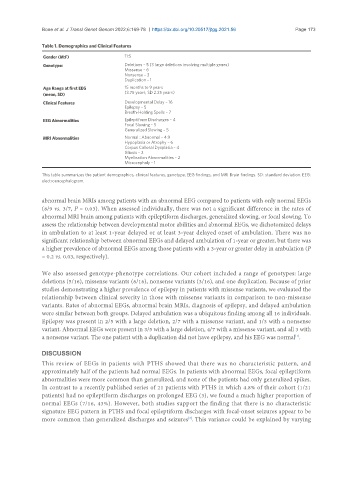
               Table 1. Demographics and Clinical Features
                Gender (M:F)               11:5
                Genotype:                  Deletions – 5 (3 large deletions involving multiple genes)
                                           Missense – 6
                                           Nonsense – 3
                                           Duplication – 1
                Age Range at first EEG     15 months to 9 years
                (mean, SD)                 (3.75 years, SD 2.25 years)
                Clinical Features          Developmental Delay – 16
                                           Epilepsy – 5
                                           Breath-Holding Spells – 7
                EEG Abnormalities          Epileptiform Discharges – 4
                                           Focal Slowing – 5
                                           Generalized Slowing – 5
                MRI Abnormalities          Normal : Abnormal – 4:9
                                           Hypoplasia or Atrophy – 6
                                           Corpus Callosal Dysplasia – 4
                                           Gliosis – 2
                                           Myelination Abnormalities – 2
                                           Microcephaly – 1
               This table summarizes the patient demographics, clinical features, genotype, EEG findings, and MRI Brain findings. SD: standard deviation. EEG:
               electroencephalogram.

               abnormal brain MRIs among patients with an abnormal EEG compared to patients with only normal EEGs
               (8/9 vs. 3/7, P = 0.03). When assessed individually, there was not a significant difference in the rates of
               abnormal MRI brain among patients with epileptiform discharges, generalized slowing, or focal slowing. To
               assess the relationship between developmental motor abilities and abnormal EEGs, we dichotomized delays
               in ambulation to at least 1-year delayed or at least 3-year delayed onset of ambulation. There was no
               significant relationship between abnormal EEGs and delayed ambulation of 1-year or greater, but there was
               a higher prevalence of abnormal EEGs among those patients with a 3-year or greater delay in ambulation (P
               = 0.2 vs. 0.03, respectively).


               We also assessed genotype-phenotype correlations. Our cohort included a range of genotypes: large
               deletions (5/16), missense variants (6/16), nonsense variants (3/16), and one duplication. Because of prior
               studies demonstrating a higher prevalence of epilepsy in patients with missense variants, we evaluated the
               relationship between clinical severity in those with missense variants in comparison to non-missense
               variants. Rates of abnormal EEGs, abnormal brain MRIs, diagnosis of epilepsy, and delayed ambulation
               were similar between both groups. Delayed ambulation was a ubiquitous finding among all 16 individuals.
               Epilepsy was present in 2/5 with a large deletion, 2/7 with a missense variant, and 1/3 with a nonsense
               variant. Abnormal EEGs were present in 3/5 with a large deletion, 4/7 with a missense variant, and all 3 with
               a nonsense variant. The one patient with a duplication did not have epilepsy, and his EEG was normal .
                                                                                                     [1]

               DISCUSSION
               This review of EEGs in patients with PTHS showed that there was no characteristic pattern, and
               approximately half of the patients had normal EEGs. In patients with abnormal EEGs, focal epileptiform
               abnormalities were more common than generalized, and none of the patients had only generalized spikes.
               In contrast to a recently published series of 21 patients with PTHS in which 4.8% of their cohort (1/21
               patients) had no epileptiform discharges on prolonged EEG (3), we found a much higher proportion of
               normal EEGs (7/16, 43%). However, both studies support the finding that there is no characteristic
               signature EEG pattern in PTHS and focal epileptiform discharges with focal-onset seizures appear to be
               more common than generalized discharges and seizures . This variance could be explained by varying
                                                                [3]

