


Page 127 - Read Online
P. 127
Li et al. J. Mater. Inf. 2026, 6, 10                                             Page 19 of 31


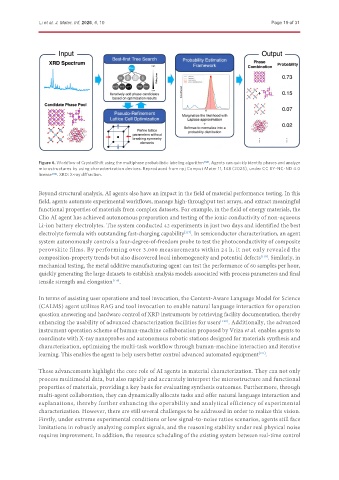
               Figure 6. Workflow of CrystalShift using the multiphase probabilistic labeling algorithm [114] . Agents can quickly identify phases and analyze
               microstructures by using characterization devices. Reproduced from npj Comput Mater 11, 148 (2025), under CC BY-NC-ND 4.0
               license [114] . XRD: X-ray diffraction.

               Beyond structural analysis, AI agents also have an impact in the field of material performance testing. In this
               field, agents automate experimental workflows, manage high-throughput test arrays, and extract meaningful
               functional properties of materials from complex datasets. For example, in the field of energy materials, the
               Clio AI agent has achieved autonomous preparation and testing of the ionic conductivity of non-aqueous
               Li-ion battery electrolytes. The system conducted 42 experiments in just two days and identified the best
               electrolyte formula with outstanding fast-charging capability . In semiconductor characterization, an agent
                                                                  [117]
               system autonomously controls a four-degree-of-freedom probe to test the photoconductivity of composite
               perovskite films. By performing over 3,000 measurements within 24 h, it not only revealed the
               composition-property trends but also discovered local inhomogeneity and potential defects . Similarly, in
                                                                                             [118]
               mechanical testing, the metal additive manufacturing agent can test the performance of 60 samples per hour,
               quickly generating the large datasets to establish analysis models associated with process parameters and final
               tensile strength and elongation .
                                         [119]
               In terms of assisting user operations and tool invocation, the Context-Aware Language Model for Science
               (CALMS) agent utilizes RAG and tool invocation to enable natural language interaction for operation
               question answering and hardware control of XRD instruments by retrieving facility documentation, thereby
               enhancing the usability of advanced characterization facilities for users [120] . Additionally, the advanced
               instrument operation scheme of human-machine collaboration proposed by Vriza et al. enables agents to
               coordinate with X-ray nanoprobes and autonomous robotic stations designed for materials synthesis and
               characterization, optimizing the multi-task workflow through human-machine interaction and iterative
               learning. This enables the agent to help users better control advanced automated equipment .
                                                                                            [121]
               These advancements highlight the core role of AI agents in material characterization. They can not only
               process multimodal data, but also rapidly and accurately interpret the microstructure and functional
               properties of materials, providing a key basis for evaluating synthesis outcomes. Furthermore, through
               multi-agent collaboration, they can dynamically allocate tasks and offer natural language interaction and
               explanations, thereby further enhancing the operability and analytical efficiency of experimental
               characterization. However, there are still several challenges to be addressed in order to realize this vision.
               Firstly, under extreme experimental conditions or low signal-to-noise ratios scenarios, agents still face
               limitations in robustly analyzing complex signals, and the reasoning stability under real physical noise
               requires improvement. In addition, the resource scheduling of the existing system between real-time control

