


Page 89 - Read Online
P. 89
Li et al. J. Mater. Inf. 2025, 5, 43  https://dx.doi.org/10.20517/jmi.2025.17   Page 11 of 23


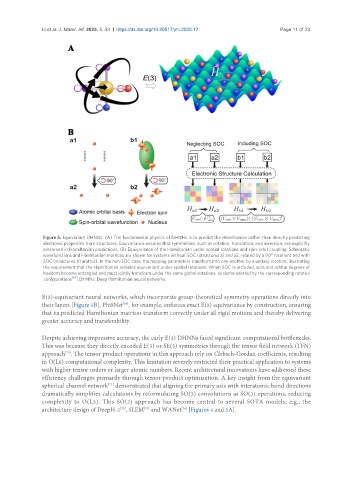
                Figure 5. Equivariant DHNNs. (A) The fundamental physics of DHNNs is to predict the Hamiltonian rather than directly predicting
                electronic properties from structures. Equivariance ensures that symmetries, such as rotation, translation, and inversion, are explicitly
                preserved in Hamiltonian predictions; (B) Equivariance of the Hamiltonian under spatial rotations and spin-orbit coupling. Schematic
                wavefunctions and Hamiltonian matrices are shown for systems without SOC (structures a1 and a2, related by a 90° rotation) and with
                SOC (structures b1 and b2). In the non-SOC case, the hopping parameters transform into one another by a unitary rotation, illustrating
                the requirement that the Hamiltonian remains equivariant under spatial rotations. When SOC is included, spin and orbital degrees of
                freedom become entangled and must jointly transform under the same global rotations, as demonstrated by the corresponding rotated
                         [67]
                configurations  . DHNNs: Deep Hamiltonian neural networks.

               E(3)-equivariant neural networks, which incorporate group-theoretical symmetry operations directly into
                                          [69]
               their layers [Figure 5B]. PhiSNet , for example, enforces exact E(3) equivariance by construction, ensuring
               that its predicted Hamiltonian matrices transform correctly under all rigid motions and thereby delivering
               greater accuracy and transferability.

               Despite achieving impressive accuracy, the early E(3) DHNNs faced significant computational bottlenecks.
               This was because they directly encoded E(3) or SE(3) symmetries through the tensor field network (TFN)
               approach . The tensor product operations in this approach rely on Clebsch-Gordan coefficients, resulting
                       [70]
               in O(L6) computational complexity. This limitation severely restricted their practical application to systems
               with higher tensor orders or larger atomic numbers. Recent architectural innovations have addressed these
               efficiency challenges primarily through tensor product optimization. A key insight from the equivariant
               spherical channel network  demonstrated that aligning the primary axis with interatomic bond directions
                                     [71]
               dramatically simplifies calculations by reformulating SO(3) convolutions as SO(2) operations, reducing
               complexity to O(L3). This SO(2) approach has become central to several SOTA models, e.g., the
                                                  [73]
                                                              [74]
               architecture design of DeepH-2 , SLEM  and WANet  [Figures 4 and 5A].
                                          [72]

