


Page 105 - Read Online
P. 105
Page 4 of 7                     Kobayashi et al. J. Mater. Inf. 2025, 5, 50  https://dx.doi.org/10.20517/jmi.2025.44


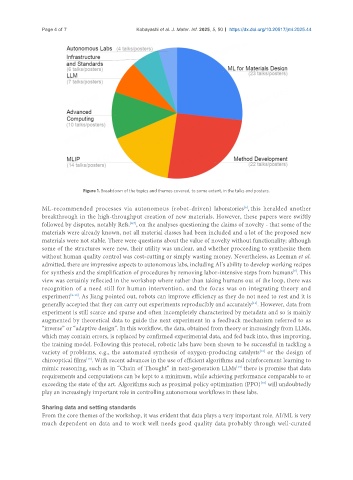
                             Figure 1. Breakdown of the topics and themes covered, to some extent, in the talks and posters.

                                                                                   [5]
               ML-recommended processes via autonomous (robot-driven) laboratories , this heralded another
               breakthrough in the high-throughput creation of new materials. However, these papers were swiftly
               followed by disputes, notably Refs. , on the analyses questioning the claims of novelty - that some of the
                                             [6,7]
               materials were already known, not all material classes had been included and a lot of the proposed new
               materials were not stable. There were questions about the value of novelty without functionality; although
               some of the structures were new, their utility was unclear, and whether proceeding to synthesize them
               without human quality control was cost-cutting or simply wasting money. Nevertheless, as Leeman et al.
               admitted, there are impressive aspects to autonomous labs, including AI’s ability to develop working recipes
                                                                                                    [7]
               for synthesis and the simplification of procedures by removing labor-intensive steps from humans . This
               view was certainly reflected in the workshop where rather than taking humans out of the loop, there was
               recognition of a need still for human intervention, and the focus was on integrating theory and
               experiment [8-10] . As Jiang pointed out, robots can improve efficiency as they do not need to rest and it is
                                                                                      [11]
               generally accepted that they can carry out experiments reproducibly and accurately . However, data from
               experiment is still scarce and sparse and often incompletely characterized by metadata and so is mainly
               augmented by theoretical data to guide the next experiment in a feedback mechanism referred to as
               “inverse” or “adaptive design”. In this workflow, the data, obtained from theory or increasingly from LLMs,
               which may contain errors, is replaced by confirmed experimental data, and fed back into, thus improving,
               the training model. Following this protocol, robotic labs have been shown to be successful in tackling a
               variety of problems, e.g., the automated synthesis of oxygen-producing catalysts  or the design of
                                                                                         [12]
                              [13]
               chirooptical films . With recent advances in the use of efficient algorithms and reinforcement learning to
               mimic reasoning, such as in “Chain of Thought” in next-generation LLMs  there is promise that data
                                                                                 [14]
               requirements and computations can be kept to a minimum, while achieving performance comparable to or
               exceeding the state of the art. Algorithms such as proximal policy optimization (PPO)  will undoubtedly
                                                                                         [15]
               play an increasingly important role in controlling autonomous workflows in these labs.

               Sharing data and setting standards
               From the core themes of the workshop, it was evident that data plays a very important role. AI/ML is very
               much dependent on data and to work well needs good quality data probably through well-curated

