


Page 80 - Read Online
P. 80
Page 4 of 31                        Shu et al. J. Mater. Inf. 2025, 5, 36  https://dx.doi.org/10.20517/jmi.2025.13


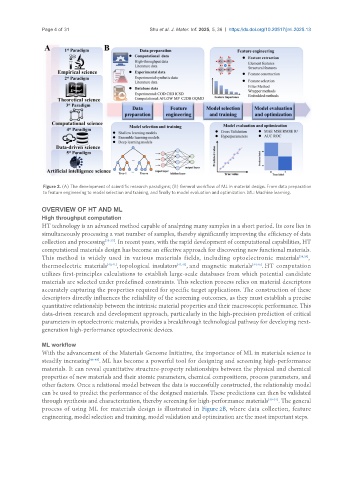
                Figure 2. (A) The development of scientific research paradigms; (B) General workflow of ML in material design. From data preparation
                to feature engineering to model selection and training, and finally to model evaluation and optimization. ML: Machine learning.


               OVERVIEW OF HT AND ML
               High throughput computation
               HT technology is an advanced method capable of analyzing many samples in a short period. Its core lies in
               simultaneously processing a vast number of samples, thereby significantly improving the efficiency of data
               collection and processing [35-37] . In recent years, with the rapid development of computational capabilities, HT
               computational materials design has become an effective approach for discovering new functional materials.
               This  method  is  widely  used  in  various  materials  fields,  including  optoelectronic  materials [38,39] ,
               thermoelectric materials [40,41] , topological insulators [42,43] , and magnetic materials [44,45] . HT computation
               utilizes first-principles calculations to establish large-scale databases from which potential candidate
               materials are selected under predefined constraints. This selection process relies on material descriptors
               accurately capturing the properties required for specific target applications. The construction of these
               descriptors directly influences the reliability of the screening outcomes, as they must establish a precise
               quantitative relationship between the intrinsic material properties and their macroscopic performance. This
               data-driven research and development approach, particularly in the high-precision prediction of critical
               parameters in optoelectronic materials, provides a breakthrough technological pathway for developing next-
               generation high-performance optoelectronic devices.


               ML workflow
               With the advancement of the Materials Genome Initiative, the importance of ML in materials science is
               steadily increasing [46-48] . ML has become a powerful tool for designing and screening high-performance
               materials. It can reveal quantitative structure-property relationships between the physical and chemical
               properties of new materials and their atomic parameters, chemical compositions, process parameters, and
               other factors. Once a relational model between the data is successfully constructed, the relationship model
               can be used to predict the performance of the designed materials. These predictions can then be validated
               through synthesis and characterization, thereby screening for high-performance materials [49-51] . The general
               process of using ML for materials design is illustrated in Figure 2B, where data collection, feature
               engineering, model selection and training, model validation and optimization are the most important steps.

