


Page 99 - Read Online
P. 99
Wu et al. J. Mater. Inf. 2025, 5, 15  https://dx.doi.org/10.20517/jmi.2024.67    Page 3 of 15


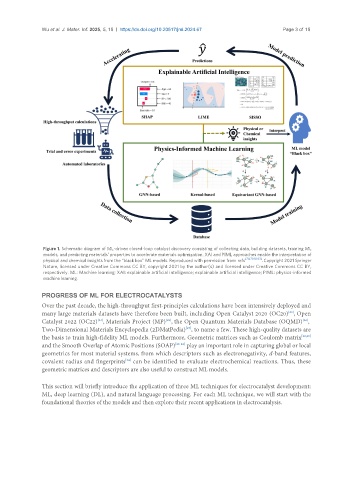
                Figure 1. Schematic diagram of ML-driven closed-loop catalyst discovery consisting of collecting data, building datasets, training ML
                models, and predicting materials’ properties to accelerate materials optimization. XAI and PIML approaches enable the interpretation of
                physical and chemical insights from the “black box” ML models. Reproduced with permission from refs [74,79,81,93] . Copyright 2021 Springer
                Nature, licensed under Creative Commons CC BY, copyright 2021 by the author(s) and licensed under Creative Commons CC BY,
                respectively. ML: Machine learning; XAI: explainable artificial intelligence; explainable artificial intelligence; PIML: physics-informed
                machine learning.


               PROGRESS OF ML FOR ELECTROCATALYSTS
               Over the past decade, the high-throughput first-principles calculations have been intensively deployed and
               many large materials datasets have therefore been built, including Open Catalyst 2020 (OC20) , Open
                                                                                                  [23]
                                  [24]
                                                                                                       [26]
               Catalyst 2022 (OC22) , Materials Project (MP) , the Open Quantum Materials Database (OQMD) ,
                                                         [25]
               Two-Dimensional Materials Encyclopedia (2DMatPedia) , to name a few. These high-quality datasets are
                                                                [27]
               the basis to train high-fidelity ML models. Furthermore, Geometric matrices such as Coulomb matrix [28,29]
               and the Smooth Overlap of Atomic Positions (SOAP) [30-33]  play an important role in capturing global or local
               geometrics for most material systems, from which descriptors such as electronegativity, d-band features,
                                           [34]
               covalent radius and fingerprints  can be identified to evaluate electrochemical reactions. Thus, these
               geometric matrices and descriptors are also useful to construct ML models.
               This section will briefly introduce the application of three ML techniques for electrocatalyst development:
               ML, deep learning (DL), and natural language processing. For each ML technique, we will start with the
               foundational theories of the models and then explore their recent applications in electrocatalysis.

