


Page 102 - Read Online
P. 102
Page 16 of 20           Andjelkovic et al. J Environ Expo Assess 2024;3:23  https://dx.doi.org/10.20517/jeea.2024.22

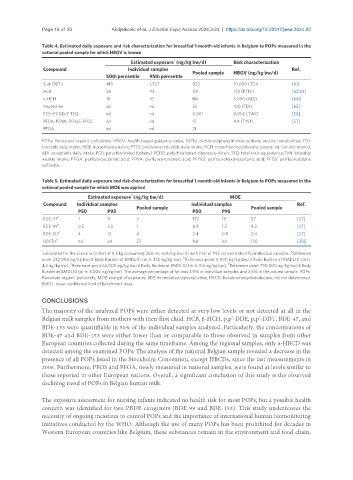
               Table 4. Estimated daily exposure and risk characterization for breastfed 1-month-old infants in Belgium to POPs measured in the
               national pooled sample for which HBGV is known
                                             Estimated exposure  (ng/kg bw/d)   Risk characterization
                                                            *
                Compound                    Individual samples    Pooled sample  HBGV (ng/kg bw/d)  Ref.
                                     50th percentile  95th percentile
                Sum DDTs             419           1,707          823           10,000 (TDI)       [61]
                HCB                  56            94             101           170 (PTDI)         [62,63]
                γ-HCH                10            10             Nd            5,000 (ADI)        [64]
                Heptachlor           nd            nd             33            100 (TDI)          [65]
                PCB+PCDD/F TEQ       nd            nd             0.061         0.002 (TWI)        [58]
                PFOA, PFNA, PFHxS, PFOS  nd        nd             17            4.4 (TWI)          [57]
                PFOA                 nd            nd             21
               POPs: Persistent organic pollutants; HBGV: health-based guidance value; DDTs: dichlorodiphenyltrichloroethane and its metabolites; TDI:
               tolerable daily intake; HCB: hexachlorobenzene; PTDI: provisional tolerable daily intake; HCH: hexachlorocyclohexane isomer; nd: not determined;
               ADI: acceptable daily intake; PCB: polychlorinated biphenyl; PCDD: polychlorinated dibenzo-p-dioxin; TEQ: total toxic equivalence;TWI: tolerable
               weakly intake; PFOA: perfluorooctanoic acid; PFNA: perfluorononanoic acid; PFHxS: perfluorohexanesulfonic acid; PFOS: perfluorooctane
               sulfonate.

               Table 5. Estimated daily exposure and risk characterization for breastfed 1-month-old infants in Belgium to POPs measured in the
               national pooled sample for which MOE was applied
                               Estimated exposure  (ng/kg bw/d)                MOE
                                             *
                Compound          Individual samples  Pooled sample  Individual samples  Pooled sample  Ref.
                           P50       P95                          P50       P95
                BDE-47 a   1         9         3                  172       19        57             [27]
                    b
                BDE-99     0.5       3.5       1                  8.4       1.2       4.2            [27]
                     c
                BDE-153    4         12        4                  2.4       0.8       2.4            [27]
                    d
                HBCDs      nd        nd        23                 Nd        nd        130            [28]
               *                                                                                   a
                calculated for the scenario (infant of 4.3 kg consuming 260 mL milk/kg bw/d) with P50 or P95 concentration for individual samples.  Reference
                                                               b
               point 232,000 ng/kg bw/d Body Burden at BMDL10 (dr h: 172 ng/kg bw),  Reference point 9,000 ng/kg bw/d Body Burden at BMDL10 (dr h:
                         c                                                    d
               4.2 ng/kg bw),  Reference point 62,000 ng/kg bw/d Body Burden at BMDL10 (dr h: 9.6 ng/kg bw),  Reference point 790,000 ng/kg bw/d Body
               Burden at BMDL10 (dr h: 3,000 ng/kg bw). The average percentage of fat was 3.9% in individual samples and 3.6% in the pooled sample. POPs:
               Persistent organic pollutants; MOE: margin of exposure; BDE: brominated diphenyl ether; HBCD: hexabromocyclododecane; nd: not determined;
               BMDL: lower confidence limit of benchmark dose.
               CONCLUSIONS
               The majority of the analyzed POPs were either detected at very low levels or not detected at all in the
               Belgian milk samples from mothers with their first child. HCB, β-HCH, p,p’-DDE, p,p’-DDT, BDE-47, and
               BDE-153 were quantifiable in 50% of the individual samples analyzed. Particularly, the concentrations of
               BDE-47 and BDE-153 were either lower than or comparable to those observed in samples from other
               European countries collected during the same timeframe. Among the regional samples, only α-HBCD was
               detected among the examined POPs. The analysis of the national Belgian sample revealed a decrease in the
               presence of all POPs listed in the Stockholm Convention, except HBCDs, since the last measurements in
               2006. Furthermore, PFOS and PFOA, newly measured in national samples, were found at levels similar to
               those reported in other European nations. Overall, a significant conclusion of this study is the observed
               declining trend of POPs in Belgian human milk.

               The exposure assessment for nursing infants indicated no health risk for most POPs, but a possible health
               concern was identified for two PBDE congeners (BDE-99 and BDE-153). This study underscores the
               necessity of ongoing measures to control POPs and the importance of international human biomonitoring
               initiatives conducted by the WHO. Although the use of many POPs has been prohibited for decades in
               Western European countries like Belgium, these substances remain in the environment and food chain,

