


Page 58 - Read Online
P. 58
Page 4 of 15                                                      Li et al. Hepatoma Res. 2026;12:36


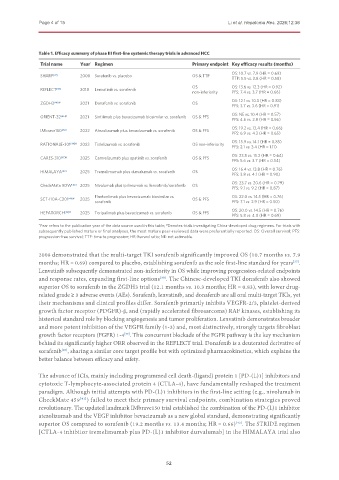
               Table 1. Efficacy summary of phase III first-line systemic therapy trials in advanced HCC
               Trial name    Year Regimen                            Primary endpoint Key efficacy results (months)
                                 *
                                                                                  OS: 10.7 vs. 7.9 (HR = 0.69)
               SHARP [37]    2008  Sorafenib vs. placebo             OS & TTP
                                                                                  TTP: 5.5 vs. 2.8 (HR = 0.58)
                                                                     OS           OS: 13.6 vs. 12.3 (HR = 0.92)
               REFLECT [38]  2018  Lenvatinib vs. sorafenib
                                                                     non-inferiority  PFS: 7.4 vs. 3.7 (HR = 0.66)
                                                                                  OS: 12.1 vs. 10.3 (HR = 0.83)
               ZGDH3 [40]#   2021  Donafenib vs. sorafenib           OS
                                                                                  PFS: 3.7 vs. 3.6 (HR = 0.91)
                                                                                  OS: NE vs. 10.4 (HR = 0.57)
               ORIENT-32 [45]#  2021  Sintilimab plus bevacizumab biosimilar vs. sorafenib  OS & PFS
                                                                                  PFS: 4.6 vs. 2.8 (HR = 0.56)
                                                                                  OS: 19.2 vs. 13.4 (HR = 0.66)
               IMbrave150 [42]  2022  Atezolizumab plus bevacizumab vs. sorafenib  OS & PFS
                                                                                  PFS: 6.9 vs. 4.3 (HR = 0.65)
                                                                                  OS: 15.9 vs. 14.1 (HR = 0.85)
               RATIONALE-301 [46]#  2023  Tislelizumab vs. sorafenib  OS non-inferiority
                                                                                  PFS: 2.1 vs. 3.4 (HR = 1.11)
                                                                                  OS: 23.8 vs. 15.2 (HR = 0.64)
               CARES-310 [47]#  2025  Camrelizumab plus apatinib vs. sorafenib  OS & PFS
                                                                                  PFS: 5.6 vs. 3.7 (HR = 0.54)
                                                                                  OS: 16.4 vs. 13.8 (HR = 0.76)
               HIMALAYA [43]  2025  Tremelimumab plus durvalumab vs. sorafenib  OS
                                                                                  PFS: 3.8 vs. 4.1 (HR = 0.90)
                                                                                  OS: 23.7 vs. 20.6 (HR = 0.79)
               CheckMate 9DW [44]  2025  Nivolumab plus ipilimumab vs. lenvatinib/sorafenib  OS
                                                                                  PFS: 9.1 vs. 9.2 (HR = 0.87)
                                  Finotonlimab plus bevacizumab biosimilar vs.    OS: 22.0 vs. 14.5 (HR = 0.76)
               SCT-I10A-C301 [48]#  2025                             OS & PFS
                                  sorafenib                                       PFS: 7.1 vs. 2.9 (HR = 0.50)
                                                                                  OS: 20.0 vs. 14.5 (HR = 0.76)
               HEPATORCH [49]#  2025  Toripalimab plus bevacizumab vs. sorafenib  OS & PFS
                                                                                  PFS: 5.8 vs. 4.0 (HR = 0.69)
               * Year refers to the publication year of the data source used in this table;  Denotes trials investigating China-developed drug regimens. For trials with
                                                           #
               subsequently published mature or final analyses, the most mature peer-reviewed data were preferentially reported. OS: Overall survival; PFS:
               progression-free survival; TTP: time to progression; HR: hazard ratio; NE: not estimable.

               2008 demonstrated that the multi-target TKI sorafenib significantly improved OS (10.7 months vs. 7.9
               months; HR = 0.69) compared to placebo, establishing sorafenib as the sole first-line standard for years .
                                                                                                        [37]
               Lenvatinib subsequently demonstrated non-inferiority in OS while improving progression-related endpoints
               and response rates, expanding first-line options . The Chinese-developed TKI donafenib also showed
                                                         [38]
               superior OS to sorafenib in the ZGDH3 trial (12.1 months vs. 10.3 months; HR = 0.83), with lower drug-
               related grade ≥ 3 adverse events (AEs). Sorafenib, lenvatinib, and donafenib are all oral multi-target TKIs, yet
               their mechanisms and clinical profiles differ. Sorafenib primarily inhibits VEGFR-2/3, platelet-derived
               growth factor receptor (PDGFR)-β, and (rapidly accelerated fibrosarcoma) RAF kinases, establishing its
               historical standard role by blocking angiogenesis and tumor proliferation. Lenvatinib demonstrates broader
               and more potent inhibition of the VEGFR family (1-3) and, most distinctively, strongly targets fibroblast
               growth factor receptors (FGFR) 1-4 . This concurrent blockade of the FGFR pathway is the key mechanism
                                             [39]
               behind its significantly higher ORR observed in the REFLECT trial. Donafenib is a deuterated derivative of
               sorafenib , sharing a similar core target profile but with optimized pharmacokinetics, which explains the
                       [40]
               better balance between efficacy and safety.

               The advance of ICIs, mainly including programmed cell death-(ligand) protein 1 [PD-(L)1] inhibitors and
               cytotoxic T-lymphocyte-associated protein 4 (CTLA-4), have fundamentally reshaped the treatment
               paradigm. Although initial attempts with PD-(L)1 inhibitors in the first-line setting (e.g., nivolumab in
               CheckMate 459 ) failed to meet their primary survival endpoints, combination strategies proved
                             [41]
               revolutionary. The updated landmark IMbrave150 trial established the combination of the PD-(L)1 inhibitor
               atezolizumab and the VEGF inhibitor bevacizumab as a new global standard, demonstrating significantly
               superior OS compared to sorafenib (19.2 months vs. 13.4 months; HR = 0.66) . The STRIDE regimen
                                                                                    [42]
               [CTLA-4 inhibitor tremelimumab plus PD-(L)1 inhibitor durvalumab] in the HIMALAYA trial also

