


Page 20 - Read Online
P. 20
Page 1692 Scattini et al. Extracell Vesicles Circ Nucleic Acids. 2026;7:1681-704
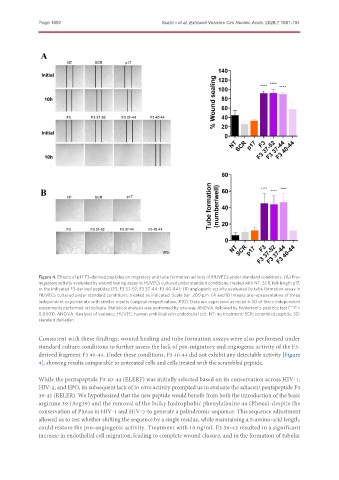
Figure 4. Effects of p17 F3-derived peptides on migratory and tube formation activity of HUVECs under standard conditions. (A) Pro-
migratory activity evaluated by wound healing assay in HUVECs cultured under standard conditions, treated with NT, SCR, full-length p17,
or the indicated F3-derived peptides (F3; F3 37-52; F3 37-44; F3 40-44); (B) angiogenic activity evaluated by tube formation assay in
HUVECs cultured under standard conditions, treated as indicated. Scale bar: 200 µm. (A and B) Images are representative of three
independent experiments with similar results (original magnification, ×10). Data are expressed as mean ± SD of three independent
experiments performed in triplicate. Statistical analysis was performed by one-way ANOVA, followed by Bonferroni’s post hoc test ( P <
****
0.0001). ANOVA: Analysis of variance; HUVEC: human umbilical vein endothelial cell; NT: no treatment; SCR: scrambled peptide; SD:
standard deviation.
Consistent with these findings, wound healing and tube formation assays were also performed under
standard culture conditions to further assess the lack of pro-migratory and angiogenic activity of the F3-
derived fragment F3 40-44. Under these conditions, F3 40-44 did not exhibit any detectable activity [Figure
4], showing results comparable to untreated cells and cells treated with the scrambled peptide.
While the pentapeptide F3 40-44 (ELERF) was initially selected based on its conservation across HIV-1,
HIV-2, and EPO, its subsequent lack of in vitro activity prompted us to evaluate the adjacent pentapeptide F3
39-43 (RELER). We hypothesized that the new peptide would benefit from both the introduction of the basic
arginine 39 (Arg39) and the removal of the bulky hydrophobic phenylalanine 44 (Phe44)-despite the
conservation of Phe44 in HIV-1 and HIV-2-to generate a palindromic sequence. This sequence adjustment
allowed us to test whether shifting the sequence by a single residue, while maintaining a 5-amino-acid length,
could restore the pro-angiogenic activity. Treatment with 10 ng/mL F3 39-43 resulted in a significant
increase in endothelial cell migration, leading to complete wound closure, and in the formation of tubular

