


Page 190 - Read Online
P. 190
Asao et al. Extracell Vesicles Circ Nucleic Acids 2023;4:461-85  https://dx.doi.org/10.20517/evcna.2023.37  Page 9


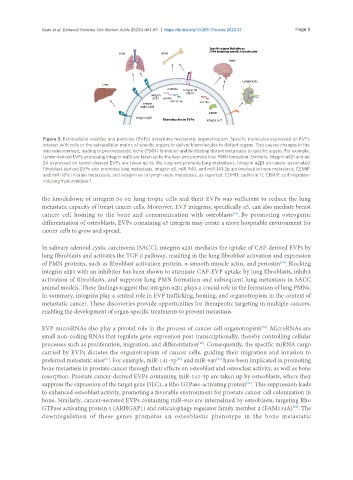
                Figure 3. Extracellular vesicles and particles (EVPs) determine metastatic organotropism. Specific molecules expressed on EVPs
                interact with cells or the extracellular matrix of specific organs to deliver biomolecules to distant organs. This causes changes in the
                microenvironment, leading to pre-metastatic niche (PMN) formation and facilitating distant metastasis to specific organs. For example,
                tumor-derived EVPs expressing integrin αvβ5 are taken up by the liver and promote liver PMN formation. Similarly, integrin α6β1 and α6
                β4 expressed on tumor-derived EVPs are taken up by the lung and promote lung metastasis. Integrin α2β1 on cancer-associated
                fibroblast-derived EVPs also promotes lung metastasis. Integrin α5, miR-940, and miR-141-3p are involved in bone metastasis, CEMIP
                and miR-181c in brain metastasis, and integrin αv in lymph node metastasis, as reported. CDH11: cadherin 11; CEMIP: cell migration
                inducing hyaluronidase 1.

               the knockdown of integrin β4 on lung tropic cells and their EVPs was sufficient to reduce the lung
               metastatic capacity of breast cancer cells. Moreover, EVP integrins, specifically α5, can also mediate breast
               cancer cell homing to the bone and communication with osteoblasts . By promoting osteogenic
                                                                               [51]
               differentiation of osteoblasts, EVPs containing α5 integrin may create a more hospitable environment for
               cancer cells to grow and spread.

               In salivary adenoid cystic carcinoma (SACC), integrin α2β1 mediates the uptake of CAF-derived EVPs by
               lung fibroblasts and activates the TGF-β pathway, resulting in the lung fibroblast activation and expression
               of PMN proteins, such as fibroblast activation protein, α-smooth muscle actin, and periostin . Blocking
                                                                                               [50]
               integrin α2β1 with an inhibitor has been shown to attenuate CAF-EVP uptake by lung fibroblasts, inhibit
               activation of fibroblasts, and suppress lung PMN formation and subsequent lung metastasis in SACC
               animal models. These findings suggest that integrin α2β1 plays a crucial role in the formation of lung PMNs.
               In summary, integrins play a central role in EVP trafficking, homing, and organotropism in the context of
               metastatic cancer. These discoveries provide opportunities for therapeutic targeting in multiple cancers,
               enabling the development of organ-specific treatments to prevent metastasis.

               EVP microRNAs also play a pivotal role in the process of cancer cell organotropism . MicroRNAs are
                                                                                         [79]
               small non-coding RNAs that regulate gene expression post-transcriptionally, thereby controlling cellular
                                                                    [80]
               processes such as proliferation, migration, and differentiation . Consequently, the specific miRNA cargo
               carried by EVPs dictates the organotropism of cancer cells, guiding their migration and invasion to
               preferred metastatic sites . For example, miR-141-3p  and miR-940  have been implicated in promoting
                                                             [82]
                                                                          [83]
                                    [81]
               bone metastasis in prostate cancer through their effects on osteoblast and osteoclast activity, as well as bone
               resorption. Prostate cancer-derived EVPs containing miR-141-3p are taken up by osteoblasts, where they
               suppress the expression of the target gene DLC1, a Rho GTPase-activating protein . This suppression leads
                                                                                    [82]
               to enhanced osteoblast activity, promoting a favorable environment for prostate cancer cell colonization in
               bone. Similarly, cancer-secreted EVPs containing miR-940 are internalized by osteoblasts, targeting Rho
                                                                                                    [83]
               GTPase activating protein 1 (ARHGAP1) and reticulophagy regulator family member 2 (FAM134A) . The
               downregulation  of  these  genes  promotes  an  osteoblastic  phenotype  in  the  bone  metastatic

