


Page 168 - Read Online
P. 168
Martin-Gonzalez et al. Energy Mater. 2025, 5, 500121  https://dx.doi.org/10.20517/energymater.2025.32  Page 23 of 35

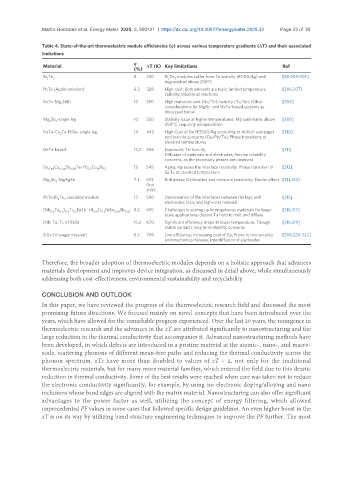
               Table 4. State-of-the-art thermoelectric module efficiencies (η) across various temperature gradients (ΔT) and their associated
               limitations
                                              η
                Material                          ΔT (K) Key limitations                        Ref
                                              (%)
                Bi Te                         8   230    Bi Te  modules suffer from Te scarcity (€1100/kg) and   [80,303-305]
                 2  3                                     2  3
                                                         degradation above 250°C
                PbTe (Apollo mission)         6.3  328   High-cost; Both elements are toxic; limited temperature   [306,307]
                                                         stability; Interfacial reactions
                GeTe-Mg SbBi                  10  350    High materials cost (Ge/Te); toxicity (Te/Sb); Other   [308]
                      3
                                                         considerations for MgSb- and GeTe-based systems as
                                                         discussed below
                Mg Sb -single leg             10  350    Stability issue at higher temperatures; Mg sublimates above   [309]
                  3  2
                                                         450°C, requiring encapsulation
                GeTe-Cu Te-PbSe- single leg   14  440    High Cost of Ge (€3500/Kg according to Aldrich webpage)   [310]
                     2
                                                         and toxicity concerns (Ge/Pb/Te); Phase transitions at
                                                         elevated temperatures
                GeTe-based                    13.3  506  Expensive; Te-toxicity;                [311]
                                                         Diffusion of materials and electrodes; Service reliability
                                                         concerns, as the secondary phases are observed
                Ge 0.89 Cu 0.06 Sb 0.08 Te-Yb Co Sb 12  12  545  Aging ingresses the interface resistivity. Phase transition in   [312]
                                  4
                               0.3
                                                         GeTe at elevated temperature
                Mg Sb -MgAgSb                 7.3  593   Brittleness; Oxidization and moisture sensitivity; Bipolar effect [313,314]
                  3
                    2
                                                  (hot
                                                  side)
                PbTe-Bi Te  cascaded module   12  590    Deterioration of the interfaces between the legs and   [315]
                    2  3
                                                         electrodes; toxic and high-cost material
                (Nb Ta ) Ti FeSb -Hf Zr NiSn 0.98 Sb 0.02  8.3  655  Challenges in scaling up homogeneous materials for large-  [316,317]
                     0.2 0.8
                                0.5
                                   0.5
                  0.8
                          0.2
                                                         scale applications; dopant Ta hard to melt and diffuse.
                (Nb, Ta, Ti, V) FeSb          15.2  670  Significant efficiency drops at lower temperature; Though   [318,319]
                                                         stable contacts long term stability concerns.
                SiGe (Voyager mission)        6.3  700   Low efficiency; Increasing cost of Ge; Prone to microcracks   [306,320-322]
                                                         and mechanical failures; Interdiffusion of electrodes
               Therefore, the broader adoption of thermoelectric modules depends on a holistic approach that advances
               materials development and improves device integration, as discussed in detail above, while simultaneously
               addressing both cost-effectiveness, environmental sustainability and recyclability.
               CONCLUSION AND OUTLOOK
               In this paper, we have reviewed the progress of the thermoelectric research field and discussed the most
               promising future directions. We focused mainly on novel concepts that have been introduced over the
               years, which have allowed for the remarkable progress experienced. Over the last 20 years, the resurgence in
               thermoelectric research and the advances in the zT are attributed significantly to nanostructuring and the
               large reduction in the thermal conductivity that accompanies it. Advanced nanostructuring methods have
               been developed, in which defects are introduced in a pristine material at the atomic-, nano-, and macro-
               scale, scattering phonons of different mean-free paths and reducing the thermal conductivity across the
               phonon spectrum. zTs have more than doubled to values of zT ~ 2, not only for the traditional
               thermoelectric materials, but for many more material families, which entered the field due to this drastic
               reduction in thermal conductivity. Some of the best results were reached when care was taken not to reduce
               the electronic conductivity significantly, for example, by using iso-electronic doping/alloying and nano
               inclusions whose band edges are aligned with the matrix material. Nanostructuring can also offer significant
               advantages to the power factor as well, utilizing the concept of energy filtering, which allowed
               unprecedented PF values in some cases that followed specific design guidelines. An even higher boost in the
               zT is on its way by utilizing band structure engineering techniques to improve the PF further. The most

