


Page 72 - Read Online
P. 72
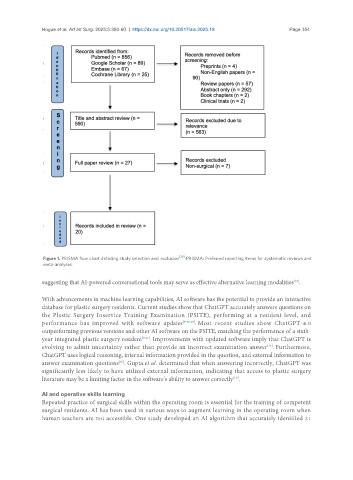
Hogue et al. Art Int Surg. 2025;5:350-60  https://dx.doi.org/10.20517/ais.2025.19                                                         Page 354


                Figure 1. PRISMA flow chart detailing study selection and exclusion [39] . PRISMA: Preferred reporting items for systematic reviews and
                meta-analyses.


                                                                                                    [18]
               suggesting that AI-powered conversational tools may serve as effective alternative learning modalities .
               With advancements in machine learning capabilities, AI software has the potential to provide an interactive
               database for plastic surgery residents. Current studies show that ChatGPT accurately answers questions on
               the Plastic Surgery Inservice Training Examination (PSITE), performing at a resident level, and
               performance  has  improved  with  software  updates [9-12,15] . Most  recent  studies  show  ChatGPT-4.0
               outperforming previous versions and other AI software on the PSITE, matching the performance of a sixth-
               year integrated plastic surgery resident [9,11] . Improvements with updated software imply that ChatGPT is
               evolving to admit uncertainty rather than provide an incorrect examination answer . Furthermore,
                                                                                           [15]
               ChatGPT uses logical reasoning, internal information provided in the question, and external information to
               answer examination questions . Gupta et al. determined that when answering incorrectly, ChatGPT was
                                         [10]
               significantly less likely to have utilized external information, indicating that access to plastic surgery
               literature may be a limiting factor in the software’s ability to answer correctly .
                                                                                [10]
               AI and operative skills learning
               Repeated practice of surgical skills within the operating room is essential for the training of competent
               surgical residents. AI has been used in various ways to augment learning in the operating room when
               human teachers are not accessible. One study developed an AI algorithm that accurately identified 21

