


Page 71 - Read Online
P. 71
Page 353                                                          Hogue et al. Art Int Surg. 2025;5:350-60  https://dx.doi.org/10.20517/ais.2025.19

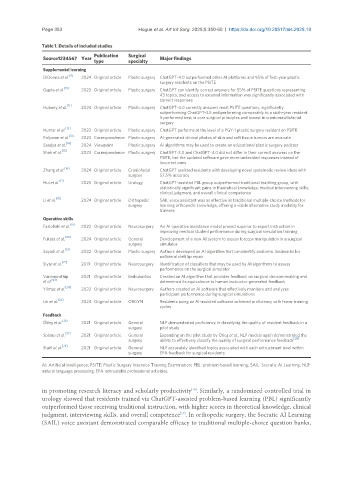
               Table 1. Details of included studies
                                 Publication   Surgical
                Source1234567 Year                     Major findings
                                 type       specialty
                Supplemental learning
                DiDonna et al. [9]  2024 Original article  Plastic surgery  ChatGPT-4.0 outperformed other AI platforms and 95% of first-year plastic
                                                       surgery residents on the PSITE
                Gupta et al. [10]  2023 Original article  Plastic surgery  ChatGPT can identify correct answers for 55% of PSITE questions representing
                                                       43 topics, and access to external information was significantly associated with
                                                       correct responses
                        [11]
                Hubany et al.  2024 Original article  Plastic surgery  ChatGPT-4.0 correctly answers most PSITE questions, significantly
                                                       outperforming ChatGPT-3.5 and performing comparably to a sixth-year resident.
                                                       It performed best in core surgical principles and lowest in craniomaxillofacial
                                                       surgery
                Humar et al. [12]  2023 Original article  Plastic surgery  ChatGPT performs at the level of a PGY-1 plastic surgery resident on PSITE
                        [13]
                Koljonen et al.  2023 Correspondence Plastic surgery  AI-generated clinical photos of skin and soft tissue tumors are accurate
                Saadya et al. [14]  2024 Viewpoint  Plastic surgery  AI algorithms may be used to create an educational plastic surgery podcast
                      [15]
                Shah et al.  2023 Correspondence Plastic surgery  ChatGPT-3.0 and ChatGPT-4.0 did not differ in their correct answers on the
                                                       PSITE, but the updated software gave more undecided responses instead of
                                                       incorrect ones
                Zhang et al. [16]  2024 Original article  Craniofacial   ChatGPT assisted residents with developing novel systematic review ideas with
                                            surgery    57.5% accuracy
                Hui et al. [17]  2025 Original article  Urology  ChatGPT-assisted PBL group outperformed traditional teaching group, with
                                                       statistically significant gains in theoretical knowledge, medical interviewing skills,
                                                       clinical judgment, and overall clinical competence
                    [18]
                Li et al.   2024 Original article  Orthopedic   SAIL voice assistant was as effective as traditional multiple-choice methods for
                                            surgery    learning orthopedic knowledge, offering a viable alternative study modality for
                                                       trainees
                Operative skills
                         [19]
                Fazlollahi et al.  2022 Original article  Neurosurgery  An AI operative assistance model proved superior to expert instruction in
                                                       improving medical student performance during surgical simulation training
                Fukata et al. [20]  2024 Original article  General   Development of a new AI system to assess forceps manipulation in a surgical
                                            surgery    simulator
                Sayadi et al. [21]  2022 Original article  Plastic surgery  Authors developed an AI algorithm that can identify anatomic landmarks for
                                                       unilateral cleft lip repair
                Siyar et al. [22]  2019 Original article  Neurosurgery  Identification of classifiers that may be used by AI algorithms to assess
                                                       performance on the surgical simulator
                Vannaprathip  2021 Original article  Endodontics  Created an AI algorithm that provides feedback on surgical decision making and
                et al. [23]                            determined its equivalence to human instructor-generated feedback
                       [24]
                Yilmaz et al.  2022 Original article  Neurosurgery  Authors created an AI software that effectively monitors and analyzes
                                                       participant performance during surgical simulations
                     [25]
                Lei et al.  2024 Original article  OBGYN  Residents using an AI-assisted software achieved proficiency with fewer training
                                                       cycles
                Feedback
                      [26]
                Ötleş et al.  2021 Original article  General   NLP demonstrated proficiency in classifying the quality of resident feedback in a
                                            surgery    pilot study
                Solano et al. [27]  2021 Original article  General   Expanding on the pilot study by Ötleş et al., NLP models again demonstrated the
                                                                                                    [26]
                                            surgery    ability to effectively classify the quality of surgical performance feedback
                Stahl et al. [28]  2021 Original article  General   NLP accurately identified topics associated with each entrustment level within
                                            surgery    EPA feedback for surgical residents
               AI: Artificial intelligence; PSITE: Plastic Surgery Inservice Training Examination; PBL: problem-based learning; SAIL: Socratic AI Learning; NLP:
               natural language processing; EPA: entrustable professional activities.

               in promoting research literacy and scholarly productivity . Similarly, a randomized controlled trial in
                                                                  [16]
               urology showed that residents trained via ChatGPT-assisted problem-based learning (PBL) significantly
               outperformed those receiving traditional instruction, with higher scores in theoretical knowledge, clinical
               judgment, interviewing skills, and overall competence . In orthopedic surgery, the Socratic AI Learning
                                                              [17]
               (SAIL) voice assistant demonstrated comparable efficacy to traditional multiple-choice question banks,

