


Page 40 - Read Online
P. 40
Page 428                                                               Liu et al. Art Int Surg. 2025;5:425-33  https://dx.doi.org/10.20517/ais.2025.01

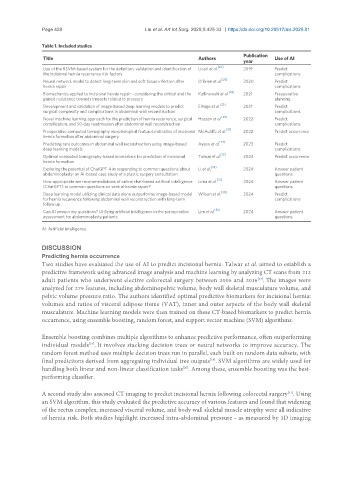
               Table 1. Included studies
                                                                                   Publication
                Title                                               Authors                   Use of AI
                                                                                   year
                                                                          [26]
                Use of the KSVM-based system for the definition, validation and identification of   Licari et al.  2019  Predict
                the incisional hernia recurrence risk factors                                 complications
                                                                            [28]
                Neural network model to detect long-term skin and soft tissue infection after   O’Brien et al.  2020  Predict
                hernia repair                                                                 complications
                                                                              [22]
                Biomechanics applied to incisional hernia repair - considering the critical and the   Kallinowski et al.  2021  Preoperative
                gained resistance towards impacts related to pressure                         planning
                Development and validation of image-based deep learning models to predict   Elhage et al. [25]  2021  Predict
                surgical complexity and complications in abdominal wall reconstruction        complications
                Novel machine learning approach for the prediction of hernia recurrence, surgical   Hassan et al. [29]  2022  Predict
                complication, and 30-day readmission after abdominal wall reconstruction      complications
                Preoperative computed tomography morphological features indicative of incisional  McAuliffe et al. [21]  2022  Predict occurrence
                hernia formation after abdominal surgery
                Predicting rare outcomes in abdominal wall reconstruction using image-based   Ayuso et al. [27]  2023  Predict
                deep learning models                                                          complications
                Optimal computed tomography-based biomarkers for prediction of incisional   Talwar et al. [17]  2024  Predict occurrence
                hernia formation
                                                                        [35]
                Exploring the potential of ChatGPT-4 in responding to common questions about   Li et al.  2024  Answer patient
                abdominoplasty: an AI-based case study of a plastic surgery consultation      questions
                                                                          [37]
                How appropriate are recommendations of online chat-based artificial intelligence   Lima et al.  2024  Answer patient
                (ChatGPT) to common questions on ventral hernia repair?                       questions
                                                                            [30]
                Deep learning model utilizing clinical data alone outperforms image-based model   Wilson et al.  2024  Predict
                for hernia recurrence following abdominal wall reconstruction with long-term   complications
                follow up
                Can AI answer my questions? Utilizing artificial intelligence in the perioperative   Lim et al. [36]  2024  Answer patient
                assessment for abdominoplasty patients                                        questions
               AI: Artificial intelligence.


               DISCUSSION
               Predicting hernia occurrence
               Two studies have evaluated the use of AI to predict incisional hernia. Talwar et al. aimed to establish a
               predictive framework using advanced image analysis and machine learning by analyzing CT scans from 212
                                                                                        [17]
               adult patients who underwent elective colorectal surgery between 2005 and 2016 . The images were
               analyzed for 279 features, including abdominopelvic volume, body wall skeletal musculature volume, and
               pelvic volume pressure ratio. The authors identified optimal predictive biomarkers for incisional hernia:
               volumes and ratios of visceral adipose tissue (VAT), inner and outer aspects of the body wall skeletal
               musculature. Machine learning models were then trained on these CT-based biomarkers to predict hernia
               occurrence, using ensemble boosting, random forest, and support vector machine (SVM) algorithms.


               Ensemble boosting combines multiple algorithms to enhance predictive performance, often outperforming
               individual models . It involves stacking decision trees or neural networks to improve accuracy. The
                               [18]
               random forest method uses multiple decision trees run in parallel, each built on random data subsets, with
               final predictions derived from aggregating individual tree outputs . SVM algorithms are widely used for
                                                                        [19]
               handling both linear and non-linear classification tasks . Among these, ensemble boosting was the best-
                                                               [20]
               performing classifier.

               A second study also assessed CT imaging to predict incisional hernia following colorectal surgery . Using
                                                                                                  [21]
               an SVM algorithm, this study evaluated the predictive accuracy of various features and found that widening
               of the rectus complex, increased visceral volume, and body wall skeletal muscle atrophy were all indicative
               of hernia risk. Both studies highlight increased intra-abdominal pressure - as measured by 3D imaging

