


Page 30 - Read Online
P. 30
Page 114                           Ding et al. Art Int Surg 2024;4:109-38  https://dx.doi.org/10.20517/ais.2024.16


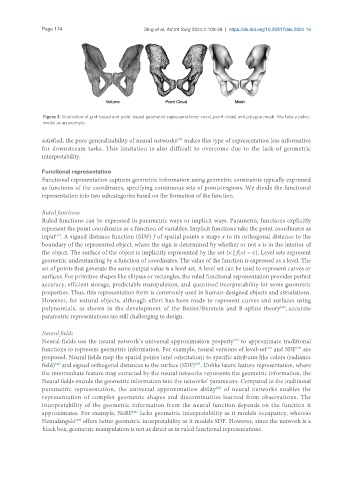
                Figure 3. Illustration of grid-based and point-based geometric representations: voxel, point cloud, and polygon mesh. We take a pelvic
                model as an example.


                                                             [42]
               satisfied, the poor generalizability of neural networks  makes this type of representation less informative
               for downstream tasks. This limitation is also difficult to overcome due to the lack of geometric
               interpretability.


               Functional representation
               Functional representation captures geometric information using geometric constraints typically expressed
               as functions of the coordinates, specifying continuous sets of points/regions. We divide the functional
               representation into two subcategories based on the formation of the function.


               Ruled functions
               Ruled functions can be expressed in parametric ways or implicit ways. Parametric functions explicitly
               represent the point coordinates as a function of variables. Implicit functions take the point coordinates as
                    [43]
               input . A signed distance function (SDF) f of spatial points x maps x to its orthogonal distance to the
               boundary of the represented object, where the sign is determined by whether or not x is in the interior of
               the object. The surface of the object is implicitly represented by the set {x | f(x) = 0}. Level sets represent
               geometric understanding by a function of coordinates. The value of the function is expressed as a level. The
               set of points that generate the same output value is a level set. A level set can be used to represent curves or
               surfaces. For primitive shapes like ellipses or rectangles, the ruled functional representation provides perfect
               accuracy, efficient storage, predictable manipulation, and quantized interpretability for some geometric
               properties. Thus, this representation form is commonly used in human-designed objects and simulations.
               However, for natural objects, although effort has been made to represent curves and surfaces using
                                                                                               [44]
               polynomials, as shown in the development of the Bezier/Berstein and B-spline theory , accurate
               parametric representations are still challenging to design.

               Neural fields
                                                                                [45]
               Neural fields use the neural network’s universal approximation property  to approximate traditional
               functions to represent geometric information. For example, neural versions of level-set  and SDF  are
                                                                                                     [47]
                                                                                           [46]
               proposed. Neural fields map the spatial points (and orientation) to specific attributes like colors (radiance
               field)  and signed orthogonal distances to the surface (SDF) . Unlike latent feature representation, where
                    [48]
                                                                   [49]
               the intermediate feature map extracted by the neural networks represents the geometric information, the
               Neural fields encode the geometric information into the networks’ parameters. Compared to the traditional
                                                                          [45]
               parametric representation, the universal approximation ability  of neural networks enables the
               representation of complex geometric shapes and discontinuities learned from observations. The
               interpretability of the geometric information from the neural function depends on the function it
               approximates. For example, NeRF  lacks geometric interpretability as it models occupancy, whereas
                                              [48]
               Neuralangelo  offers better geometric interpretability as it models SDF. However, since the network is a
                          [49]
               black box, geometric manipulation is not as direct as in ruled functional representations.

