


Page 51 - Read Online
P. 51
Raffetto et al. Vessel Plus 2021;5:36  https://dx.doi.org/10.20517/2574-1209.2021.16  Page 17 of 30

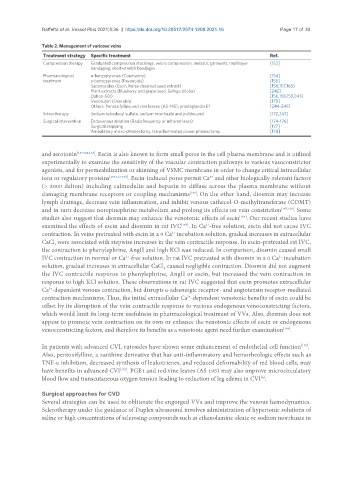
               Table 2. Management of varicose veins
                Treatment strategy  Specific treatment                                      Ref.
                Compression therapy  Graduated compression stockings, velcro compression, inelastic garments, multilayer   [152]
                                bandaging, short-stretch bandages
                Pharmacological   α-benzopyrones (Coumarins)                                [154]
                treatment       γ-benzopyrones (Favonoids)                                  [155]
                                Saponosides (Escin, horse chestnut seed extract)            [156,157,163]
                                Plant extracts (Blueberry and grape seed, Ginkgo biloba)    [242]
                                Daflon-500                                                  [156,158,159,243]
                                Venoruton (Oxerutin)                                        [170]
                                Others: Pentoxifylline, red vine leaves (AS-195), prostaglandin E1  [244-246]
                Sclerotherapy   Sodium tetradecyl sulfate, sodium morrhuate and polidocanol  [172,247]
                Surgical intervention  Endovenous ablation (Radiofrequency or infrared laser)   [174-176]
                                Surgical stripping                                          [177]
                                Ambulatory micro-phlebectomy, transilluminated power phlebectomy  [178]


               and serotonin [157,162,163] . Escin is also known to form small pores in the cell plasma membrane and is utilized
               experimentally to examine the sensitivity of the vascular contraction pathways to various vasoconstrictor
               agonists, and for permeabilization or skinning of VSMC membrane in order to change critical intracellular
               ions or regulatory proteins [157,163-165] . Escin-induced pores permit Ca  and other biologically-relevant factors
                                                                        2+
               (> 3000 dalton) including calmodulin and heparin to diffuse across the plasma membrane without
               damaging membrane receptors or coupling mechanisms . On the other hand, diosmin may increase
                                                                 [166]
               lymph drainage, decrease vein inflammation, and inhibit venous cathecol-O-methyltransferase (COMT)
               and in turn decrease norepinephrine metabolism and prolong its effects on vein constriction [167,168] . Some
               studies also suggest that diosmin may enhance the venotonic effects of escin . Our recent studies have
                                                                                  [164]
                                                              [169]
               examined the effects of escin and diosmin in rat IVC . In Ca -free solution, escin did not cause IVC
                                                                      2+
               contraction. In veins pretreated with escin in a 0 Ca  incubation solution, gradual increases in extracellular
                                                           2+
               CaCl  were associated with stepwise increases in the vein contractile response. In escin-pretreated rat IVC,
                   2
               the contraction to phenylephrine, AngII and high KCl was reduced. In comparison, diosmin caused small
               IVC contraction in normal or Ca -free solution. In rat IVC pretreated with diosmin in a 0 Ca  incubation
                                           2+
                                                                                               2+
               solution, gradual increases in extracellular CaCl  caused negligible contraction. Diosmin did not augment
                                                        2
               the IVC contractile response to phenylephrine, AngII or escin, but increased the vein contraction in
               response to high KCl solution. These observations in rat IVC suggested that escin promotes extracellular
               Ca -dependent venous contraction, but disrupts α-adrenergic receptor- and angiotensin receptor-mediated
                 2+
                                                                2+
               contraction mechanisms. Thus, the initial extracellular Ca -dependent venotonic benefits of escin could be
               offset by its disruption of the vein contractile response to various endogenous venoconstricting factors,
               which would limit its long-term usefulness in pharmacological treatment of VVs. Also, diosmin does not
               appear to promote vein contraction on its own or enhance the venotonic effects of escin or endogenous
               venoconstricting factors, and therefore its benefits as a venotonic agent need further examination .
                                                                                                [169]
                                                                                                      [170]
               In patients with advanced CVI, rutosides have shown some enhancement of endothelial cell function .
               Also, pentoxifylline, a xanthine derivative that has anti-inflammatory and hemorheologic effects such as
               TNF-α inhibition, decreased synthesis of leukotrienes, and reduced deformability of red blood cells, may
               have benefits in advanced CVI . PGE1 and red vine leaves (AS 195) may also improve microcirculatory
                                          [171]
               blood flow and transcutaneous oxygen tension leading to reduction of leg edema in CVI .
                                                                                         [4]
               Surgical approaches for CVD
               Several strategies can be used to obliterate the engorged VVs and improve the venous hemodynamics.
               Sclerotherapy under the guidance of Duplex ultrasound involves administration of hypertonic solutions of
               saline or high concentrations of sclerosing compounds such as ethanolamine oleate or sodium morrhuate in

