


Page 44 - Read Online
P. 44
Ren et al. Soft Sci. 2026, 6, 6                                                  Page 15 of 33


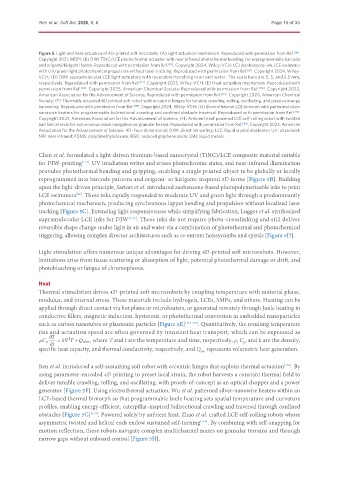
               Figure 5. Light and heat actuation of 4D-printed soft microbots. (A) Light actuation mechanism. Reproduced with permission from Ref. [110] .
               Copyright 2021, MDPI; (B) DIW TiNC/LCE photochromic actuator with near infrared photothermal bending, for reprogrammable barcode
               and origami/kirigami forms. Reproduced with permission from Ref. [111] . Copyright 2024, Wiley-VCH; (C) Azobenzene-ink LCE swimmer
               with UV/green light photochemical propulsion without laser tracking. Reproduced with permission from Ref. [29] . Copyright 2024, Wiley-
               VCH; (D) DIW supramolecular LCE light actuators with reversible morphing in air and water. The scale bars are 5, 5, and 2.5 mm,
               respectively. Reproduced with permission from Ref. [112] . Copyright 2023, Wiley-VCH; (E) Heat actuation mechanism. Reproduced with
               permission from Ref. [30] . Copyright 2025, American Chemical Society; Reproduced with permission from Ref.  [115] . Copyright 2022,
               American Association for the Advancement of Science; Reproduced with permission from Ref. [114] . Copyright 2020, American Chemical
               Society; (F) Thermally actuated 4D printed soft robot with eccentric hinges for tunable crawling, rolling, oscillating, and passive energy
               harvesting. Reproduced with permission from Ref. [116] . Copyright 2024, Wiley-VCH; (G) Electrothermal LCE bimorph with patterned silver
               nanowire heaters for programmable bidirectional crawling and confined obstacle traversal. Reproduced with permission from Ref. [117] .
               Copyright 2023, American Association for the Advancement of Science; (H) Ambient heat powered LCE self-rolling robot with twisted
               and helical ends for autonomous maze navigation on granular terrain. Reproduced with permission from Ref. [118] . Copyright 2023, American
               Association for the Advancement of Science. 4D: Four-dimensional; DIW: direct ink writing; LCE: liquid crystal elastomer; UV: ultraviolet;
               NIR: near infrared; PDMS: polydimethylsiloxane; RGO: reduced graphene oxide; LMs: liquid metals.


               Chen et al. formulated a light-driven titanium-based nanocrystal (TiNC)/LCE composite material suitable
               for DIW-printing . UV irradiation writes and erases photochromic states, and near-infrared illumination
                              [111]
               provides photothermal bending and gripping, enabling a single printed object to be globally or locally
               reprogrammed into barcode patterns and origami- or kirigami-inspired 3D forms [Figure 5B]. Building
               upon the light-driven principle, Sartori et al. introduced azobenzene-based photopolymerizable inks to print
               LCE swimmers . These inks rapidly responded to moderate UV and green light through a predominantly
                            [29]
               photochemical mechanism, producing synchronous lappet bending and propulsion without localized laser
               tracking [Figure 5C]. Extending light responsiveness while simplifying fabrication, Lugger et al. synthesized
               supramolecular LCE inks for DIW [112] . These inks do not require photo-crosslinking and still deliver
               reversible shape change under light in air and water via a combination of photothermal and photochemical
               triggering, allowing complex director architectures such as re-entrant honeycombs and spirals [Figure 5D].


               Light stimulation offers numerous unique advantages for driving 4D-printed soft microrobots. However,
               limitations arise from tissue scattering or absorption of light, potential photothermal damage or drift, and
               photobleaching or fatigue of chromophores.


               Heat
               Thermal stimulation drives 4D-printed soft microrobots by coupling temperature with material phase,
               modulus, and internal stress. These materials include hydrogels, LCEs, SMPs, and others. Heating can be
               applied through direct contact via hot plates or microheaters, or generated remotely through Joule heating in
               conductive fillers, magnetic induction, hysteresis, or photothermal conversion in embedded nanoparticles
               such as carbon nanotubes or plasmonic particles [Figure 5E] [113-115] . Quantitatively, the resulting temperature
               rise and actuation speed are often governed by transient heat transport, which can be expressed as
                         2
                                                                                       p
                              =   ∇    +    abs , where T and t are the temperature and time, respectively, ρ, C , and k are the density,
               specific heat capacity, and thermal conductivity, respectively, and Q  represents volumetric heat generation.
                                                                       abs
               Ren et al. introduced a self-sustaining soft robot with eccentric hinges that exploits thermal actuation . By
                                                                                                     [116]
               using parameter-encoded 4D printing to preset local strain, the robot harvests a constant thermal field to
               deliver tunable crawling, rolling, and oscillating, with proofs-of-concept as an optical chopper and a power
               generator [Figure 5F]. Using electrothermal actuation, Wu et al. patterned silver-nanowire heaters within an
               LCE-based thermal bimorph so that programmable Joule heating sets spatial temperature and curvature
               profiles, enabling energy-efficient, caterpillar-inspired bidirectional crawling and traversal through confined
               obstacles [Figure 5G] [117] . Powered solely by ambient heat, Zhao et al. crafted LCE self-rolling robots whose
               asymmetric twisted and helical ends endow sustained self-turning [118] . By combining with self-snapping for
               motion reflection, these robots navigate complex multichannel mazes on granular terrains and through
               narrow gaps without onboard control [Figure 5H].

