


Page 5 - Read Online
P. 5
Zou et al. Soft Sci 2024;4:19  https://dx.doi.org/10.20517/ss.2024.13            Page 3 of 10


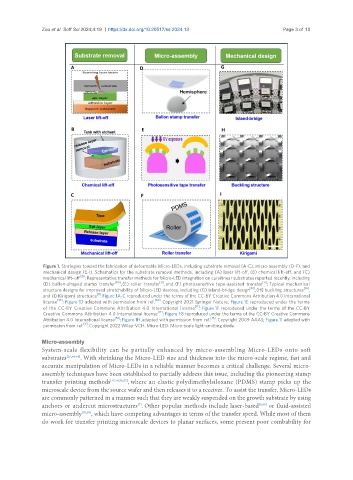
                Figure 1. Strategies toward the fabrication of deformable Micro-LEDs, including substrate removal (A-C), micro-assembly (D-F), and
                mechanical design (E-I). Schematics for the substrate removal methods, including (A) laser lift-off, (B) chemical lift-off, and (C)
                mechanical lift-off [35] ; Representative transfer methods for Micro-LED integration on curvilinear substrates reported recently, including
                                                       [11]
                (D) ballon-shaped stamp  transfer [60] , (E) roller  transfer , and (F) photosensitive tape-assisted  transfer [17] ; Typical mechanical
                structure designs for improved stretchability of Micro-LED devices, including (G) island-bridge  design [61] , (H) buckling  structures [16] ,
                                  [9]
                and (I) Kirigami structures . Figure 1A-C reproduced under the terms of the CC-BY Creative Commons Attribution 4.0 International
                license [35] ; Figure 1D adapted with permission from  ref. [60] . Copyright 2021 Springer Nature; Figure 1E reproduced under the terms
                                                                   [11]
                of  the  CC-BY  Creative  Commons  Attribution  4.0  International  license ; Figure 1F  reproduced  under  the  terms  of  the  CC-BY
                Creative Commons Attribution 4.0 International license [17] ; Figure 1G reproduced under the terms of the CC-BY Creative Commons
                Attribution 4.0 International license [61] ; Figure 1H adapted with permission from  ref. [16] . Copyright 2009 AAAS; Figure 1I adapted with
                             [9]
                permission from ref. . Copyright 2022 Wiley-VCH. Micro-LED: Micro-scale light-emitting diode.
               Micro-assembly
               System-scale  flexibility  can  be  partially  enhanced  by  micro-assembling  Micro-LEDs  onto  soft
               substrates [35,54-56] . With shrinking the Micro-LED size and thickness into the micro-scale regime, fast and
               accurate manipulation of Micro-LEDs in a reliable manner becomes a critical challenge. Several micro-
               assembly techniques have been established to partially address this issue, including the pioneering stamp
               transfer printing methods [15,16,56,57] , where an elastic polydimethylsiloxane (PDMS) stamp picks up the
               microscale device from the source wafer and then releases it to a receiver. To assist the transfer, Micro-LEDs
               are commonly patterned in a manner such that they are weakly suspended on the growth substrate by using
               anchors or undercut microstructures . Other popular methods include laser-based [6,58]  or fluid-assisted
                                               [7]
               micro-assembly [55,59] , which have competing advantages in terms of the transfer speed. While most of them
               do work for transfer printing microscale devices to planar surfaces, some present poor combability for

