


Page 85 - Read Online
P. 85
Page 10 of 18           Billings et al. Plast Aesthet Res. 2025;12:27  https://dx.doi.org/10.20517/2347-9264.2025.52

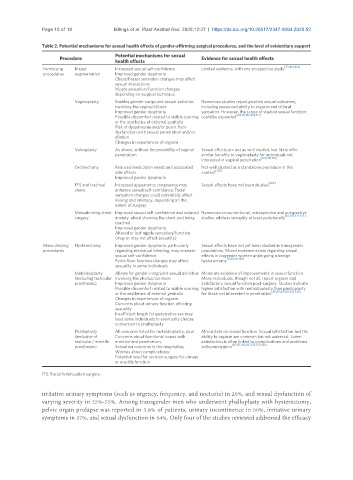
               Table 2. Potential mechanisms for sexual health effects of gender-affirming surgical procedures, and the level of evidentiary support
                                        Potential mechanisms for sexual
                     Procedure                                       Evidence for sexual health effects
                                        health effects
                                                                                                 [73,102,103]
                Feminizing   Breast     Increased sexual self-confidence   Limited evidence, with one prospective study
                procedures  augmentation  Improved gender dysphoria
                                        Chest/breast sensation changes may affect
                                        sexual interactions
                                        Nipple sensation/function changes
                                        depending on surgical technique
                          Vaginoplasty  Enables gender-congruent sexual activities   Numerous studies report positive sexual outcomes,
                                        involving the vagina/clitoris   including preserved ability to orgasm and clitoral
                                        Improved gender dysphoria    sensation. However, the scope of studied sexual function
                                                                                 [24,30,102,104-117]
                                        Possible discomfort related to visible scarring  could be expanded
                                        or the aesthetics of external genitalia
                                        Risk of dyspareunia and/or pelvic floor
                                        dysfunction with sexual penetration and/or
                                        dilation
                                        Changes in experiences of orgasm
                          Vulvoplasty   As above, without the possibility of vaginal   Sexual effects are not as well studied, but likely offer
                                        penetration                  similar benefits to vaginoplasty for individuals not
                                                                                         [108,118,119]
                                                                     interested in vaginal penetration
                          Orchiectomy   Reduced medication needs and associated   Not well studied as a standalone procedure in this
                                        side effects                 context [120]
                                        Improved gender dysphoria
                          FFS and tracheal   Increased appearance congruence may   Sexual effects have not been studied [102]
                          shave         enhance sexual self-confidence. Facial
                                        sensation changes could potentially affect
                                        kissing and intimacy, depending on the
                                        extent of surgery
                          Masculinizing chest  Improved sexual self-confidence and reduced  Numerous cross-sectional, retrospective and prospective
                                                                                                 [67,103,121-125]
                          surgery       anxiety  about showing the chest and being   studies address sexuality at least peripherally
                                        touched
                                        Improved gender dysphoria
                                        Altered or lost nipple sensation/function
                                        (may or may not affect sexuality)
                Masculinizing   Hysterectomy  Improved gender dysphoria, particularly   Sexual effects have not yet been studied in transgender
                procedures              regarding menstrual bleeding, may increase   populations. Mixed evidence exists regarding sexual
                                        sexual self-confidence       effects in cisgender women undergoing a benign
                                                                             [102,126-129]
                                        Pelvic floor function changes may affect   hysterectomy
                                        sexuality in some individuals
                          Metoidioplasty   Allows for gender-congruent sexual activities  Moderate evidence of improvements in sexual function.
                          (including testicular  involving the phallus/scrotum   Many individuals, though not all, report orgasm and
                          prostheses)   Improved gender dysphoria    satisfactory sexual function post-surgery. Studies indicate
                                        Possible discomfort related to visible scarring  higher satisfaction with metoidioplasty than phalloplasty
                                                                                             [85,87,89,102,130-136]
                                        or the aesthetics of external genitalia   for those not interested in penetration
                                        Changes in experiences of orgasm
                                        Concerns about urinary function affecting
                                        sexuality
                                        Insufficient length for penetrative sex may
                                        lead some individuals to eventually choose
                                        conversion to phalloplasty
                          Phalloplasty   All concerns listed for metoidioplasty, plus:   Mixed data on sexual function. Sexual satisfaction and the
                          (inclusive of   Concerns about functional issues with   ability to orgasm are common but not universal. Lower
                          testicular/ erectile   erection and penetration;   satisfaction is often linked to complications and problems
                                                                               [87,87,102,107,133,137-142]
                          prostheses)   Sensation concerns in the neophallus;   with penetration
                                        Worries about complications;
                                        Potential need for revision surgery for urinary
                                        or erectile function
               FFS: Facial feminization surgery.


               irritative urinary symptoms (such as urgency, frequency, and nocturia) in 20%, and sexual dysfunction of
               varying severity in 25%-75%. Among transgender men who underwent phalloplasty with hysterectomy,
               pelvic organ prolapse was reported in 3.8% of patients, urinary incontinence in 50%, irritative urinary
               symptoms in 37%, and sexual dysfunction in 54%. Only four of the studies reviewed addressed the efficacy

