


Page 64 - Read Online
P. 64
Page 4 of 9            Kawakibi et al. Plast Aesthet Res 2023;10:48  https://dx.doi.org/10.20517/2347-9264.2022.120


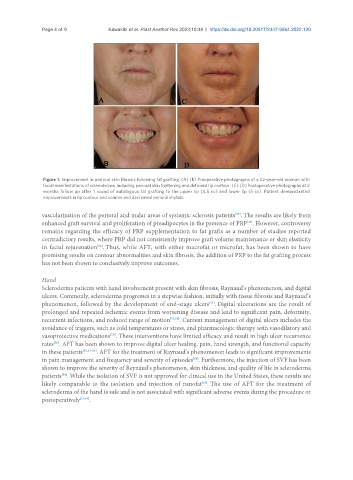
                Figure 1. Improvement in perioral skin fibrosis following fat grafting. (A) (B) Preoperative photographs of a 52-year-old woman with
                facial manifestations of scleroderma, including perioral skin tightening and deficient lip contour. (C) (D) Postoperative photographs at 2
                months follow up after 1 round of autologous fat grafting to the upper lip (4.5 cc) and lower lip (5 cc). Patient demonstrated
                improvements in lip contour and volume and decreased perioral rhytids.

               vascularization of the perioral and malar areas of systemic sclerosis patients . The results are likely from
                                                                                [55]
               enhanced graft survival and proliferation of preadipocytes in the presence of PRP . However, controversy
                                                                                    [43]
               remains regarding the efficacy of PRP supplementation to fat grafts as a number of studies reported
               contradictory results, where PRP did not consistently improve graft volume maintenance or skin elasticity
                                  [56]
               in facial rejuvenation . Thus, while AFT, with either macrofat or microfat, has been shown to have
               promising results on contour abnormalities and skin fibrosis, the addition of PRP to the fat grafting process
               has not been shown to conclusively improve outcomes.


               Hand
               Scleroderma patients with hand involvement present with skin fibrosis, Raynaud’s phenomenon, and digital
               ulcers. Commonly, scleroderma progresses in a stepwise fashion, initially with tissue fibrosis and Raynaud’s
               phenomenon, followed by the development of end-stage ulcers . Digital ulcerations are the result of
                                                                       [45]
               prolonged and repeated ischemic events from worsening disease and lead to significant pain, deformity,
               recurrent infections, and reduced range of motion [57,58] . Current management of digital ulcers includes the
               avoidance of triggers, such as cold temperatures or stress, and pharmacologic therapy with vasodilatory and
               vasoprotective medications . These interventions have limited efficacy and result in high ulcer recurrence
                                      [59]
               rates . AFT has been shown to improve digital ulcer healing, pain, hand strength, and functional capacity
                   [60]
               in these patients [58,61-63] . AFT for the treatment of Raynaud’s phenomenon leads to significant improvements
               in pain management and frequency and severity of episodes . Furthermore, the injection of SVF has been
                                                                  [64]
               shown to improve the severity of Reynaud’s phenomenon, skin thickness, and quality of life in scleroderma
               patients . While the isolation of SVF is not approved for clinical use in the United States, these results are
                      [54]
                                                                     [65]
               likely comparable to the isolation and injection of nanofat . The use of AFT for the treatment of
               scleroderma of the hand is safe and is not associated with significant adverse events during the procedure or
               postoperatively [54,64] .

