


Page 10 - Read Online
P. 10
Braswell et al. Plast Aesthet Res 2024;11:46  https://dx.doi.org/10.20517/2347-9264.2023.136  Page 5 of 10


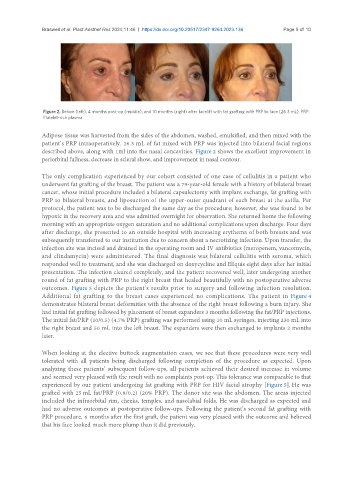
                Figure 2. Before (left), 4 months post-op (middle), and 10 months (right) after facelift with fat grafting with PRP to face (26.3 mL). PRP:
                Platelet-rich plasma.


               Adipose tissue was harvested from the sides of the abdomen, washed, emulsified, and then mixed with the
               patient’s PRP intraoperatively. 26.3 mL of fat mixed with PRP was injected into bilateral facial regions
               described above, along with 1ml into the nasal concavities. Figure 2 shows the excellent improvement in
               periorbital fullness, decrease in scleral show, and improvement in nasal contour.

               The only complication experienced by our cohort consisted of one case of cellulitis in a patient who
               underwent fat grafting of the breast. The patient was a 79-year-old female with a history of bilateral breast
               cancer, whose initial procedure included a bilateral capsulectomy with implant exchange, fat grafting with
               PRP to bilateral breasts, and liposuction of the upper-outer quadrant of each breast at the axilla. Per
               protocol, the patient was to be discharged the same day as the procedure; however, she was found to be
               hypoxic in the recovery area and was admitted overnight for observation. She returned home the following
               morning with an appropriate oxygen saturation and no additional complications upon discharge. Four days
               after discharge, she presented to an outside hospital with increasing erythema of both breasts and was
               subsequently transferred to our institution due to concern about a necrotizing infection. Upon transfer, the
               infection site was incised and drained in the operating room and IV antibiotics (meropenem, vancomycin,
               and clindamycin) were administered. The final diagnosis was bilateral cellulitis with seroma, which
               responded well to treatment, and she was discharged on doxycycline and Eliquis eight days after her initial
               presentation. The infection cleared completely, and the patient recovered well, later undergoing another
               round of fat grafting with PRP to the right breast that healed beautifully with no postoperative adverse
               outcomes. Figure 3 depicts the patient’s results prior to surgery and following infection resolution.
               Additional fat grafting to the breast cases experienced no complications. The patient in Figure 4
               demonstrates bilateral breast deformities with the absence of the right breast following a burn injury. She
               had initial fat grafting followed by placement of breast expanders 3 months following the fat/PRP injections.
               The initial fat/PRP (10/0.5) (4.7% PRP) grafting was performed using 10 mL syringes, injecting 230 mL into
               the right breast and 50 mL into the left breast. The expanders were then exchanged to implants 2 months
               later.

               When looking at the elective buttock augmentation cases, we see that these procedures were very well
               tolerated  with  all  patients  being  discharged  following  completion  of  the  procedure  as  expected.  Upon
               analyzing these patients’ subsequent follow-ups, all patients achieved their desired increase in volume
               and seemed very pleased with the result with no complaints post-op. This tolerance was comparable to that
               experienced by our patient undergoing fat grafting with PRP for HIV facial atrophy [Figure 5]. He was
               grafted with 25 mL fat/PRP (0.8/0.2) (20% PRP). The donor site was the abdomen. The areas injected
               included the infraorbital rim, cheeks, temples, and nasolabial folds. He was discharged as expected and
               had no adverse outcomes at postoperative follow-ups. Following the patient’s second fat grafting with
               PRP procedure, 6 months after the first graft, the patient was very pleased with the outcome and believed
               that his face looked much more plump than it did previously.

