


Page 64 - Read Online
P. 64
Gulati et al. Metab Target Organ Damage 2024;4:9  https://dx.doi.org/10.20517/mtod.2023.45  Page 13 of 17


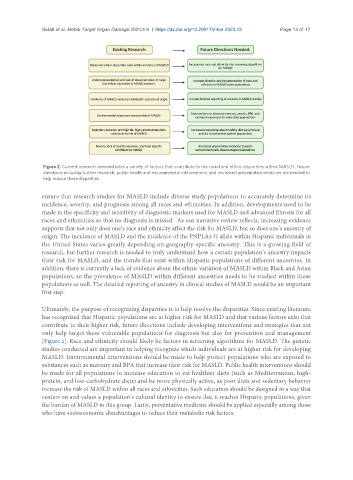
                Figure 2. Current research demonstrates a variety of factors that contribute to the racial and ethnic disparities within MASLD. Future
                directions including further research, public health and environmental interventions, and increased preventative medicine are needed to
                help reduce these disparities.

               ensure that research studies for MASLD include diverse study populations to accurately determine its
               incidence, severity, and prognosis among all races and ethnicities. In addition, developments need to be
               made in the specificity and sensitivity of diagnostic markers used for MASLD and advanced fibrosis for all
               races and ethnicities so that no diagnosis is missed.  As our narrative review reflects, increasing evidence
               supports that not only does one’s race and ethnicity affect the risk for MASLD, but so does one’s ancestry of
               origin. The incidence of MASLD and the incidence of the PNPLA3 G allele within Hispanic individuals in
               the United States varies greatly depending on geography-specific ancestry. This is a growing field of
               research, but further research is needed to truly understand how a certain population’s ancestry impacts
               their risk for MASLD, and the trends that exist within Hispanic populations of different ancestries. In
               addition, there is currently a lack of evidence about the ethnic variation of MASLD within Black and Asian
               populations, so the prevalence of MASLD within different ancestries needs to be studied within those
               populations as well. The detailed reporting of ancestry in clinical studies of MASLD would be an important
               first step.

               Ultimately, the purpose of recognizing disparities is to help resolve the disparities. Since existing literature
               has recognized that Hispanic populations are at higher risk for MASLD and that various factors exist that
               contribute to their higher risk, future directions include developing interventions and strategies that not
               only help target these vulnerable populations for diagnosis but also for prevention and management
               [Figure 2]. Race and ethnicity should likely be factors in screening algorithms for MASLD. The genetic
               studies conducted are important in helping recognize which individuals are at higher risk for developing
               MASLD. Environmental interventions should be made to help protect populations who are exposed to
               substances such as mercury and BPA that increase their risk for MASLD. Public health interventions should
               be made for all populations to increase education to eat healthier diets (such as Mediterranean, high-
               protein, and low-carbohydrate diets) and be more physically active, as poor diets and sedentary behavior
               increase the risk of MASLD within all races and ethnicities. Such education should be designed in a way that
               centers on and values a population’s cultural identity to ensure that it reaches Hispanic populations, given
               the burden of MASLD in this group. Lastly, preventative medicine should be applied especially among those
               who have socioeconomic disadvantages to reduce their metabolic risk factors.

