


Page 163 - Read Online
P. 163
Page 6 of 22               D’Aimmo et al. Microbiome Res Rep 2024;3:11  https://dx.doi.org/10.20517/mrr.2023.59


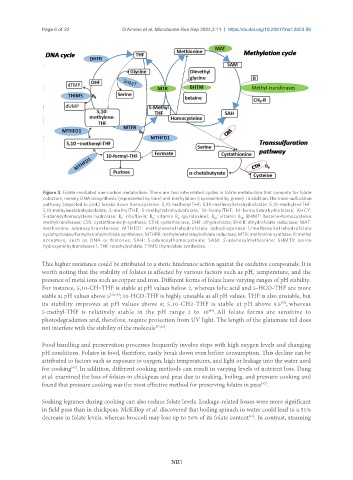
                Figure 3. Folate-mediated one-carbon metabolism. There are two interrelated cycles in folate metabolism that compete for folate
                cofactors, namely DNA biosynthesis (represented by blue) and methylation (represented by green). In addition, the trans-sulfuration
                pathway (depicted in pink) breaks down homocysteine. 5,10-methenylTHF: 5,10-methenyltetrahydrofolate; 5,10-methyleneTHF:
                5,10-methylenetetrahydrofolate;  5-methylTHF:  5-methyltetrahydrofolate;  10-formylTHF:  10-formyltetrahydrofolate;  AHCY:
                S-adenosylhomocysteine  hydrolase;  B :  riboflavin;  B :  vitamin  B   (pyridoxine);  B :  vitamin  B ;  BHMT:  betaine-homocysteine
                                          2
                                                    6
                                                                                  12
                                                                         12
                                                             6
                methyltransferase; CBS: cystathionine β-synthase; CTH: cystathionase, DHF: dihydrofolate; DHFR: dihydrofolate reductase; MAT:
                methionine  adenosyltransferase;  MTHFD1:  methylenetetrahydrofolate  dehydrogenase  1/methenyltetrahydrofolate
                cyclohydrolase/formyltetrahydrofolate synthetase; MTHFR: methylenetetrahydrofolate reductase; MTR: methionine synthase; R: methyl
                acceptors,  such  as  DNA  or  histones;  SAH:  S-adenosylhomocysteine;  SAM:  S-adenosylmethionine;  SHMT1:  serine
                hydroxymethyltransferase 1; THF: tetrahydrofolate; TYMS: thymidylate synthetase.
               This higher resistance could be attributed to a steric hindrance action against the oxidative compounds. It is
               worth noting that the stability of folates is affected by various factors such as pH, temperature, and the
               presence of metal ions such as copper and iron. Different forms of folate have varying ranges of pH stability.
               For instance, 5,10-CH=THF is stable at pH values below 2, whereas folic acid and 5-HCO-THF are more
               stable at pH values above 5 [38,39] ; 10-HCO-THF is highly unstable at all pH values. THF is also unstable, but
               its stability improves at pH values above 8; 5,10-CH2-THF is stable at pH above 9.5 , whereas
                                                                                                [39]
               5-methyl-THF  is  relatively  stable  in  the  pH  range  2  to  10 . All  folate  forms  are  sensitive  to
                                                                       [40]
               photodegradation and, therefore, require protection from UV light. The length of the glutamate tail does
               not interfere with the stability of the molecule [35,41] .


               Food handling and preservation processes frequently involve steps with high oxygen levels and changing
               pH conditions. Folates in food, therefore, easily break down even before consumption. This decline can be
               attributed to factors such as exposure to oxygen, high temperatures, and light or leakage into the water used
               for cooking . In addition, different cooking methods can result in varying levels of nutrient loss. Dang
                         [42]
               et al. examined the loss of folates in chickpeas and peas due to soaking, boiling, and pressure cooking and
                                                                                         [42]
               found that pressure cooking was the most effective method for preserving folates in peas .

               Soaking legumes during cooking can also reduce folate levels. Leakage-related losses were more significant
               in field peas than in chickpeas. McKillop et al. discovered that boiling spinach in water could lead to a 51%
               decrease in folate levels, whereas broccoli may lose up to 56% of its folate content . In contrast, steaming
                                                                                     [43]

