


Page 50 - Read Online
P. 50
Page 4 of 11              Pang et al. Mini-invasive Surg 2024;8:27  https://dx.doi.org/10.20517/2574-1225.2023.124

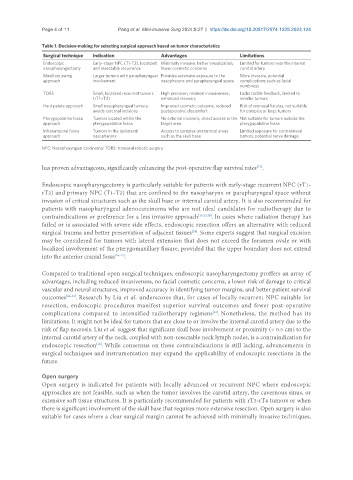
               Table 1. Decision-making for selecting surgical approach based on tumor characteristics
                Surgical technique  Indication         Advantages                 Limitations
                Endoscopic      Early-stage NPC (T1-T2), localized  Minimally invasive, better visualization,   Limited for tumors near the internal
                nasopharyngectomy  and resectable recurrence  fewer cosmetic concerns  carotid artery
                Maxillary swing   Larger tumors with parapharyngeal  Provides extensive exposure to the   More invasive, potential
                approach        involvement            nasopharynx and parapharyngeal space  complications such as facial
                                                                                  numbness
                TORS            Small, localized recurrent tumors   High precision, minimal invasiveness,   Lacks tactile feedback, limited to
                                (rT1-rT2)              enhanced recovery          smaller tumors
                Hard palate approach  Small nasopharyngeal tumors;   Improved cosmetic outcome, reduced   Risk of oronasal fistulas, not suitable
                                avoids external incisions  postoperative discomfort  for complex or large tumors
                Pterygopalatine fossa   Tumors located within the   No external incisions, direct access to the  Not suitable for tumors outside the
                approach        pterygopalatine fossa  target area                pterygopalatine fossa
                Infratemporal fossa   Tumors in the ipsilateral   Access to complex anatomical areas   Limited exposure for contralateral
                approach        nasopharynx            such as the skull base     tumors, potential nerve damage

               NPC: Nasopharyngeal carcinoma; TORS: transoral robotic surgery.

                                                                                        [23]
               has proven advantageous, significantly enhancing the post-operative flap survival rates .

               Endoscopic nasopharyngectomy is particularly suitable for patients with early-stage recurrent NPC (rT1-
               rT2) and primary NPC (T1-T2) that are confined to the nasopharynx or parapharyngeal space without
               invasion of critical structures such as the skull base or internal carotid artery. It is also recommended for
               patients with nasopharyngeal adenocarcinoma who are not ideal candidates for radiotherapy due to
               contraindications or preference for a less invasive approach [16,23,24] . In cases where radiation therapy has
               failed or is associated with severe side effects, endoscopic resection offers an alternative with reduced
                                                                  [14]
               surgical trauma and better preservation of adjacent tissues . Some experts suggest that surgical excision
               may be considered for tumors with lateral extension that does not exceed the foramen ovale or with
               localized involvement of the pterygomaxillary fissure, provided that the upper boundary does not extend
               into the anterior cranial fossa [25-27] .


               Compared to traditional open surgical techniques, endoscopic nasopharyngectomy proffers an array of
               advantages, including reduced invasiveness, no facial cosmetic concerns, a lower risk of damage to critical
               vascular and neural structures, improved accuracy in identifying tumor margins, and better patient survival
               outcomes [28-31] . Research by Liu et al. underscores that, for cases of locally recurrent NPC suitable for
               resection, endoscopic procedures manifest superior survival outcomes and fewer post-operative
               complications compared to intensified radiotherapy regimens . Nonetheless, the method has its
                                                                         [16]
               limitations. It might not be ideal for tumors that are close to or involve the internal carotid artery due to the
               risk of flap necrosis. Liu et al. suggest that significant skull base involvement or proximity (< 0.5 cm) to the
               internal carotid artery of the neck, coupled with non-resectable neck lymph nodes, is a contraindication for
                                 [16]
               endoscopic resection . While consensus on these contraindications is still lacking, advancements in
               surgical techniques and instrumentation may expand the applicability of endoscopic resections in the
               future.


               Open surgery
               Open surgery is indicated for patients with locally advanced or recurrent NPC where endoscopic
               approaches are not feasible, such as when the tumor involves the carotid artery, the cavernous sinus, or
               extensive soft tissue structures. It is particularly recommended for patients with rT3-rT4 tumors or when
               there is significant involvement of the skull base that requires more extensive resection. Open surgery is also
               suitable for cases where a clear surgical margin cannot be achieved with minimally invasive techniques,

