


Page 70 - Read Online
P. 70
Page 84                                        Ragni et al. Extracell Vesicles Circ Nucleic Acids. 2026;7:73-93


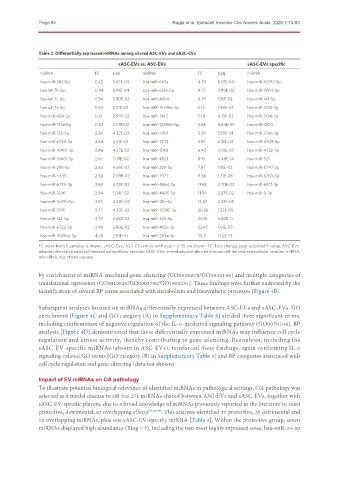
               Table 2. Differentially expressed miRNAs among shared ASC-EVs and sASC-EVs
                                           sASC-EVs vs. ASC-EVs                         sASC-EVs specific

               miRNA              FC     padj      miRNA               FC    padj       miRNA
               hsa-miR-382-5p     0.22   5.63E-03  hsa-miR-663a        4.70  8.01E-04   hsa-miR-10392-5p
               hsa-let-7b-5p      0.44   8.41E-04  hsa-miR-6516-5p     4.77  2.99E-02   hsa-miR-129-2-3p
               hsa-let-7c-5p      0.54   3.80E-02  hsa-miR-4454        4.79  1.13E-02   hsa-miR-141-5p
               hsa-let-7a-5p      0.60   2.31E-02  hsa-miR-10396b-3p   5.15  1.59E-04   hsa-miR-3130-3p
               hsa-miR-424-3p     0.61   2.99E-02  hsa-miR-1843        5.18  4.13E-03   hsa-miR-3184-3p
               hsa-miR-125a-5p    0.63   2.27E-02  hsa-miR-10396b-5p   5.28  9.64E-05   hsa-miR-3650
               hsa-miR-138-5p     2.26   4.32E-02  hsa-miR-9901        5.50  1.59E-04   hsa-miR-376b-3p
               hsa-miR-6724-5p    2.44   3.31E-02  hsa-miR-7973        5.55  2.31E-02   hsa-miR-4709-5p
               hsa-miR-10401-3p   2.46   4.37E-02  hsa-miR-1248        6.42  1.09E-02   hsa-miR-4732-3p
               hsa-miR-10401-5p   2.61   1.09E-02  hsa-miR-4521        6.91  4.48E-14   hsa-miR-521
               hsa-miR-29b-3p     2.62   4.39E-02  hsa-miR-222-5p      7.87  1.13E-02   hsa-miR-6747-3p
               hsa-miR-4449       2.68   2.09E-02  hsa-miR-7977        9.86  1.41E-06   hsa-miR-6763-3p
               hsa-miR-6739-3p    2.69   4.29E-02  hsa-miR-4664-3p     11.68  3.70E-03  hsa-miR-6817-3p
               hsa-miR-1246       2.94   1.04E-02  hsa-miR-4485-5p     11.99  2.27E-02  hsa-miR-9-3p
               hsa-miR-10395-5p   3.55   4.40E-02  hsa-miR-10b-3p      13.87  2.32E-05
               hsa-miR-3195       3.77   4.39E-02  hsa-miR-10395-3p    20.56  1.53E-05
               hsa-miR-142-5p     3.78   3.46E-02  hsa-miR-205-5p      21.30  5.60E-11
               hsa-miR-6752-3p    3.99   3.80E-02  hsa-miR-4536-3p     33.67  1.61E-03
               hsa-miR-10396a-3p  4.28   2.51E-03  hsa-miR-203a-3p     35.11  1.02E-13
               FC mean from 5 samples is shown. sASC-EVs/ASC-EVs ratios with padj < 0.05 are shown. FC: Fold change; padj: adjusted P-value; ASC-EVs:
               adipose-derived stromal cell-derived extracellular vesicles; sASC-EVs: sorted adipose-derived stromal cell-derived extracellular vesicles; miRNA:
               microRNA; hsa: Homo sapiens.

               by enrichment of miRNA-mediated gene silencing (GO0035278/GO0035195) and multiple categories of
               translational repression (GO0010629/GO0003730/GO1903231). These findings were further endorsed by the
               identification of several BP terms associated with metabolism and biosynthetic processes [Figure 4B].

               Subsequent analyses focused on miRNAs differentially expressed between ASC-EVs and sASC-EVs. GO
               enrichment [Figure 4C and GO category (A) in Supplementary Table 3] yielded three significant terms,
               including confirmation of negative regulation of the IL-6-mediated signaling pathway (GO0070104). BP
               analysis [Figure 4D] demonstrated that these differentially expressed miRNAs may influence cell cycle
               regulation and kinase activity, thereby contributing to gene silencing. Reanalysis, including the
               sASC-EV-specific miRNAs (absent in ASC-EVs), reinforced these findings, again confirming IL-6
               signaling-related GO terms [GO category (B) in Supplementary Table 3] and BP categories associated with
               cell cycle regulation and gene silencing (data not shown).

               Impact of EV miRNAs on OA pathology
               To illustrate potential biological relevance of identified miRNAs in pathological settings, OA pathology was
               selected as a model disease to sift the 271 miRNAs shared between ASC-EVs and sASC-EVs, together with
               sASC-EV-specific players, due to a broad knowledge of miRNAs previously reported in the literature to exert
               protective, detrimental, or overlapping effects [25,26,27] . This analysis identified 31 protective, 20 detrimental and
               12 overlapping miRNAs, plus one sASC-EV-specific miRNA [Table 3]. Within the protective group, seven
               miRNAs displayed high abundance (Rlog > 7), including the two most highly expressed ones, hsa-miR-24-3p

