


Page 100 - Read Online
P. 100
Miceli. Extracell Vesicles Circ Nucleic Acids. 2026;7:20-33                          Page 24


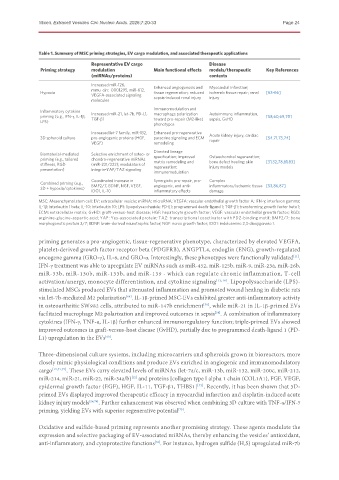
               Table 1. Summary of MSC priming strategies, EV cargo modulation, and associated therapeutic applications
                                 Representative EV cargo                   Disease
               Priming strategy  modulation            Main functional effects  models/therapeutic  Key References
                                 (miRNAs/proteins)                         contexts
                                 Increased miR-126,
                                 mmu_circ_0001295, miR-612,  Enhanced angiogenesis and  Myocardial infarction;
               Hypoxia                                 tissue regeneration; reduced  ischemic tissue repair; renal  [63-66]
                                 VEGFA-associated signaling
                                 molecules             sepsis-induced renal injury  injury
                                                       Immunomodulation and
               Inflammatory cytokine  Increased miR-21, let-7b, PD-L1,  macrophage polarization  Autoimmune inflammation,
               priming (e.g., IFN-γ, IL-1β,  TGF-β1    toward pro-repair (M2-like)  sepsis, GvHD  [58,60,69,70]
               LPS)
                                                       phenotypes
                                 Increased let-7 family, miR-132,  Enhanced pro-regenerative
               3D spheroid culture  pro-angiogenic proteins (HGF,  paracrine signaling and ECM  Acute kidney injury, cardiac  [54,71,73,74]
                                 VEGF)                 remodeling          repair
                                                       Directed lineage
               Biomaterial-mediated  Selective enrichment of osteo- or  specification; improved  Osteochondral regeneration;
               priming (e.g., tailored  chondro-regenerative miRNAs  matrix remodeling and  bone defect healing; skin  [31,32,78,81,83]
               stiffness, RGD    (miR-221/222); modulators of  regeneration;  injury models
               presentation)     integrin-YAP/TAZ signaling
                                                       immunomodulation
                                 Coordinated increase in  Synergistic pro-repair, pro-  Complex
               Combined priming (e.g.,  BMP2/7, BDNF, NGF, VEGF,  angiogenic, and anti-  inflammatory/ischemic tissue [53,86,87]
               3D + hypoxia/cytokines)
                                 IDO1, IL-10           inflammatory effects  damage
               MSC: Mesenchymal stem cell; EV: extracellular vesicle; miRNA: microRNA; VEGFA: vascular endothelial growth factor A; IFN-γ: interferon gamma;
               IL-1β: interleukin 1 beta; IL-10: interleukin 10; LPS: lipopolysaccharide; PD-L1: programmed death-ligand 1; TGF-β1: transforming growth factor beta 1;
               ECM: extracellular matrix; GvHD: graft-versus-host disease; HGF: hepatocyte growth factor; VEGF: vascular endothelial growth factor; RGD:
               arginine-glycine-aspartic acid; YAP: Yes-associated protein; TAZ: transcriptional coactivator with PDZ-binding motif; BMP2/7: bone
               morphogenetic protein 2/7; BDNF: brain-derived neurotrophic factor; NGF: nerve growth factor; IDO1: indoleamine 2,3-dioxygenase 1.


               priming generates a pro-angiogenic, tissue-regenerative phenotype, characterized by elevated VEGFA,
               platelet-derived growth factor receptor beta (PDGFRB), ANGPTL4, endoglin (ENG), growth-regulated
               oncogene gamma (GRO-γ), IL-8, and GRO-α. Interestingly, these phenotypes were functionally validated .
                                                                                                        [11]
               IFN-γ treatment was able to upregulate EV miRNAs such as miR-452, miR-125b, miR-9, miR-23a, miR-26b,
               miR-33b, miR-130b, miR-133b, and miR-139 - which can regulate chronic inflammation, T-cell
               activation/anergy, monocyte differentiation, and cytokine signaling [12,16] . Lipopolysaccharide (LPS)-
               stimulated MSCs produced EVs that attenuated inflammation and promoted wound healing in diabetic rats
               via let-7b-mediated M2 polarization . IL-1β-primed MSC-EVs exhibited greater anti-inflammatory activity
                                             [69]
               in osteoarthritic SW982 cells, attributed to miR-147b enrichment , while miR-21 in IL-1β-primed EVs
                                                                        [70]
               facilitated macrophage M2 polarization and improved outcomes in sepsis . A combination of inflammatory
                                                                             [58]
               cytokines (IFN-γ, TNF-α, IL-1β) further enhanced immunoregulatory function; triple-primed EVs showed
               improved outcomes in graft-versus-host disease (GvHD), partially due to programmed death-ligand 1 (PD-
               L1) upregulation in the EVs .
                                      [60]

               Three-dimensional culture systems, including microcarriers and spheroids grown in bioreactors, more
               closely mimic physiological conditions and produce EVs enriched in angiogenic and immunomodulatory
               cargo [12,71,72] . These EVs carry elevated levels of miRNAs (let-7a/c, miR-13b, miR-132, miR-200c, miR-212,
               miR-214, miR-21, miR-22, miR-34a/b)  and proteins [collagen type I alpha 1 chain (COL1A1), FGF, VEGF,
                                               [12]
               epidermal growth factor (EGF), HGF, IL-11, TGF-β1, THBS1] . Recently, it has been shown that 3D-
                                                                      [73]
               primed EVs displayed improved therapeutic efficacy in myocardial infarction and cisplatin-induced acute
               kidney injury models [54,74] . Further enhancement was observed when combining 3D culture with TNF-α/IFN-  γ
               priming, yielding EVs with superior regenerative potential .
                                                                [75]
               Oxidative and sulfide-based priming represents another promising strategy. These agents modulate the
               expression and selective packaging of EV-associated miRNAs, thereby enhancing the vesicles’ antioxidant,
               anti-inflammatory, and cytoprotective functions . For instance, hydrogen sulfide (H 2S) upregulated miR-7b
                                                       [33]

