


Page 172 - Read Online
P. 172
Page 14  Ribovski et al. Extracell Vesicles Circ Nucleic Acids 2023;4:283-305  https://dx.doi.org/10.20517/evcna.2023.26


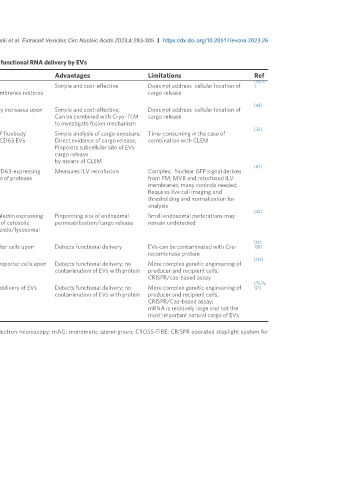
 Table 2. Assays to detect membrane fusion, cargo exposure, subcellular site of cargo release, and functional RNA delivery by EVs

 Assay type  Mechanism  Advantages                   Limitations                          Ref
                                                                                          [58,117
 Fluorescence   Membrane fusion  Lipid-mixing/   Simple and cost-effective   Does not address  cellular location of   ]
 quenching based on   Fusion of the PS:PC:Chol-R18 liposomes with lipid membranes restores   cargo release
 R18  fluorescence
                                                                                          [68]
 DiI-DiD-based FRET  Membrane fusion (EVs with   Lipid-mixing/DiI and DiD as FRET pair (donor intensity increases upon   Simple and cost-effective;   Does not address  cellular location of
 assay  LUVs)  fusion)   Can be combined with Cryo-TEM   cargo release
                    to investigate fusion mechanism
                                                                                          [22]
 Nanobody assay;   EV cargo exposure; detection  Punctate structure formation upon binding of anti-GFP fluobody   Simple analysis of cargo exposure;  Time-consuming in the case of
 CLEM  of subcellular site of cargo   (expressed in recipient cells) to GFP cargo from GFP-CD63 EVs  Direct evidence of cargo release;   combination with CLEM
 release            Pinpoints subcellular site of EVs
                    cargo release
                    by means of CLEM
                                                                                          [87]
 Retrofusion assay  Membrane fusion (ILV   Nuclear accumulation of NLS-GFP in NLS-GFP-TCS-CD63-expressing   Measures ILV retrofusion  Complex;  Nuclear GFP signal derives
 retrofusion)  cells that co-express split TEV protease, upon addition of protease   from PM, MVB and retrofused ILV
 dimerizer                                           membranes; many controls needed;
                                                     Requires live cell imaging and
                                                     thresholding and normalization for
                                                     analysis
                                                                                          [22]
 Galectin assay  Endosomal permeabilization  Endosomal accumulation of mAG-galectin in mAG-galectin expressing   Pinpointing site of endosomal   Small endosomal perforations may
 cells upon endosomal permeabilization, i.e., exposure of cytosolic   permeabilization/cargo release  remain undetected
 galectins to β-galactosides present exclusively in the endo/lysosomal
 lumen.
                                                                                          [127,
 Cre-recombinase  mRNA delivery  RFP to GFP fluorescence conversion in recipient reporter cells upon   Detects functional delivery  EVs can be contaminated with Cre-  128]
 addition of Cre-recombinase mRNA-containing EVs     recombinase protein
                                                                                          [126]
 CROSS-FIRE  sgRNA delivery  mCherry to GFP fluorescence conversion in recipient reporter cells upon   Detects functional delivery; no   More complex genetic engineering of
 addition of sgRNA-containing EVs  contamination of EVs with protein  producer and recipient cells;
                                                     CRISPR/cas-based assay
                                                                                          [75,76,
 REMD  mRNA delivery  Luciferase expression in recipient reporter cells upon delivery of EVs   Detects functional delivery; no   More complex genetic engineering of   121]
 containing NanoLuc mRNA with a stop codon  contamination of EVs with protein  producer and recipient cells;
                                                     CRISPR/Cas-based assay;
                                                     mRNA is relatively large and not the
                                                     most important natural cargo of EVs

 LUVs: large unilamellar vesicles; TEM: transmission electron microscopy; CLEM: correlative light and electron microscopy; mAG: monomeric azami-green; CROSS-FIRE: CRISPR operated stoplight system for
 functional intercellular RNA exchange; REMD: RNA-editing-based mRNA delivery.


 different proteins play a role.

