


Page 5 - Read online
P. 5
Original Article  |  Open Access

                                          Carbon Footprints


                                        Maffia et al. Carbon Footprints 2026, 5, 7      DOI:10.20517/cf.2025.91


               Sustainable fertilizers from wastes: a strategy to
               enhance soil carbon, improve soil quality, and
               mitigate emissions


               Angela Maffia, Federica Marra, Santo Battaglia, Carmelo Mallamaci, Adele Muscolo

               Keywords:
               Compost, digestate, life
               cycle assessment, microbial
               community, organic
               amendments, soil carbon
               sequestration,
               sulfur-bentonite,
               vermicompost

               Citation: Maffia, A.;
               Marra, F.; Battaglia, S.;
               Mallamaci, C.; Muscolo, A.
               Sustainable fertilizers from
               wastes: a strategy to
               enhance soil carbon,
               improve soil quality, and
               mitigate emissions. Carbon
               Footprints 2026, 5, 7.
               https://dx.doi.org/10.20517
               /cf.2025.91         Abstract
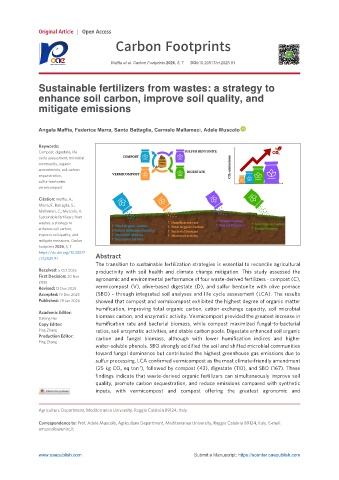
                                   The transition to sustainable fertilization strategies is essential to reconcile agricultural
               Received: 5 Oct 2025  productivity   with   soil   health   and   climate   change   mitigation.   This   study   assessed   the
               First Decision: 20 Nov  agronomic and environmental performance of four waste-derived fertilizers - compost (C),
               2025
               Revised: 12 Dec 2025  vermicompost   (V),   olive-based   digestate   (D),   and   sulfur   bentonite   with   olive   pomace
               Accepted: 19 Dec 2025  (SBO)  -  through  integrated  soil  analyses  and  life  cycle  assessment  (LCA).  The  results
               Published: 29 Jan 2026  showed that compost and vermicompost exhibited the highest degree of organic matter
                                   humification,   improving   total   organic   carbon,   cation   exchange   capacity,   soil   microbial
               Academic Editor:
               Dafeng Hui          biomass carbon, and enzymatic activity. Vermicompost provided the greatest increase in
               Copy Editor:        humification   rate   and   bacterial   biomass,   while   compost   maximized   fungal-to-bacterial
               Ping Zhang          ratios, soil enzymatic activities, and stable carbon pools. Digestate enhanced soil organic
               Production Editor:  carbon   and   fungal   biomass,   although   with   lower   humification   indices   and   higher
               Ping Zhang
                                   water-soluble phenols. SBO strongly acidified the soil and shifted microbial communities
                                   toward fungal dominance but contributed the highest greenhouse gas emissions due to
                                   sulfur processing. LCA confirmed vermicompost as the most climate-friendly amendment
                                   (25 kg CO 2  eq ton ), followed by compost (43), digestate (110), and SBO (167). These
                                                  -1
                                   findings  indicate  that  waste-derived  organic  fertilizers  can  simultaneously  improve  soil
                                   quality,  promote  carbon  sequestration,  and  reduce  emissions  compared  with  synthetic
                                   inputs,   with   vermicompost   and   compost   offering   the   greatest   agronomic   and


               Agriculture Department, Mediterranea University, Reggio Calabria 89124, Italy.

               Correspondence to: Prof. Adele Muscolo, Agriculture Department, Mediterranea University, Reggio Calabria 89124, Italy. E-mail:
               amuscolo@unirc.it


               www.oaepublish.com                                    Submit a Manuscript: https://ucenter.oaepublish.com

