


Page 23 - Read Online
P. 23
Talwar et al. Art Int Surg. 2025;5:46-52  https://dx.doi.org/10.20517/ais.2024.81     Page 48

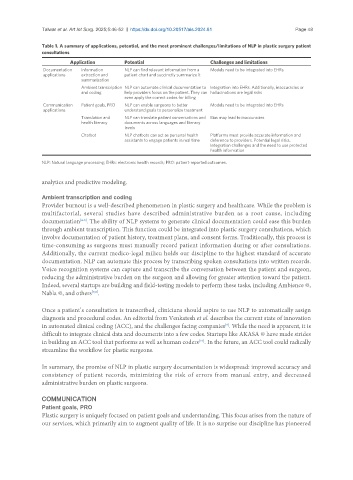
               Table 1. A summary of applications, potential, and the most prominent challenges/limitations of NLP in plastic surgery patient
               consultations
                         Application       Potential                    Challenges and limitations
                Documentation   Information   NLP can find relevant information from a   Models need to be integrated into EHRs
                applications  extraction and   patient chart and succinctly summarize it
                            summarization
                            Ambient transcription  NLP can automate clinical documentation to  Integration into EHRs. Additionally, inaccuracies or
                            and coding     help providers focus on the patient. They can  hallucinations are legal risks
                                           even apply the correct codes for billing
                Communication   Patient goals, PRO  NLP can enable surgeons to better   Models need to be integrated into EHRs
                applications               understand goals to personalize treatment
                            Translation and   NLP can translate patient conversations and  Bias may lead to inaccuracies
                            health literacy  documents across languages and literacy
                                           levels
                            Chatbot        NLP chatbots can act as personal health   Platforms must provide accurate information and
                                           assistants to engage patients in real time  deference to providers. Potential legal risks.
                                                                        Integration challenges and the need to use protected
                                                                        health information

               NLP: Natural language processing; EHRs: electronic health records; PRO: patient-reported outcomes.


               analytics and predictive modeling.

               Ambient transcription and coding
               Provider burnout is a well-described phenomenon in plastic surgery and healthcare. While the problem is
               multifactorial,  several  studies  have  described  administrative  burden  as  a  root  cause,  including
               documentation . The ability of NLP systems to generate clinical documentation could ease this burden
                            [4-6]
               through ambient transcription. This function could be integrated into plastic surgery consultations, which
               involve documentation of patient history, treatment plans, and consent forms. Traditionally, this process is
               time-consuming as surgeons must manually record patient information during or after consultations.
               Additionally, the current medico-legal milieu holds our discipline to the highest standard of accurate
               documentation. NLP can automate this process by transcribing spoken consultations into written records.
               Voice recognition systems can capture and transcribe the conversation between the patient and surgeon,
               reducing the administrative burden on the surgeon and allowing for greater attention toward the patient.
               Indeed, several startups are building and field-testing models to perform these tasks, including Ambience ©,
               Nabla ©, and others .
                                [7,8]
               Once a patient’s consultation is transcribed, clinicians should aspire to use NLP to automatically assign
               diagnosis and procedural codes. An editorial from Venkatesh et al. describes the current state of innovation
               in automated clinical coding (ACC), and the challenges facing companies . While the need is apparent, it is
                                                                             [9]
               difficult to integrate clinical data and documents into a few codes. Startups like AKASA © have made strides
               in building an ACC tool that performs as well as human coders . In the future, an ACC tool could radically
                                                                    [10]
               streamline the workflow for plastic surgeons.

               In summary, the promise of NLP in plastic surgery documentation is widespread: improved accuracy and
               consistency of patient records, minimizing the risk of errors from manual entry, and decreased
               administrative burden on plastic surgeons.


               COMMUNICATION
               Patient goals, PRO
               Plastic surgery is uniquely focused on patient goals and understanding. This focus arises from the nature of
               our services, which primarily aim to augment quality of life. It is no surprise our discipline has pioneered

